Showing posts with label James Donald. Show all posts

Friday, 4 December 2020

Quatermass and the Pit (1967)

 “You realise what you’re implying? That we owe our human condition to the intervention of insects?”

I thought, after all this time, that I'd better get roumd to the last of Hammer's cinematic adaptations of Nigel Kneale's Quatermass serials. This, an adaptation of the best of the three serials, is entirely unlike- and better than- the previous two, both of which were among the earliest Hammer horrors in the early '50s, to the extent that their right to that label may seem somewhat tenuous. But this is 1967, the very height of Hammer Horror...and much more clearly a horror film.

The film does not, of course, match the TV original in quality, necessarily truncated though it is. Much is excused, including Quatermass’ concluding monologue, although the script, by Kneale himself, is a superbly done adaptation. The story is one of mood, theme and character rather than cinematic visuals, but the cinematic medium allows for the building of a feeling of dread towards the end, and a much more visual ending.

Andrew Keir, although good, is no Andre Morell, but both Barbara Shelley and Julian Glover are first rate, and James Donald slowly grew on me. More so than the excellence of the cast, though, the film works superbly well as an old school horror film built on suspense and ideas rather than spectacle, keeping the subtext but moving things in a different direction from the original. And it really, really works.

This, I think, is absolutely one of the finest Hammers.

Friday, 8 May 2020

The Way Ahead (1944)

"I wonder what we'll look like in 1970, ."

I write this on the seventy-fifth anniversary of VE Day, in 2020. It's a weird anniversary, during the Great Plague and in the midst of lockdown. But oddly enough spirits seem to be raised. I took Little Miss Llamastrangler out on her scooter this afternoon and lots of people have decorated their front gardens and are socialising from a distance. A decent amount of alcohol, I hope, has been consumed. I'm doing my bit. The anniversary of Nazi rule being crushed is well worth celebrating, and can perhaps give us hope.

So what better to blog than a wartime propaganda film from 1944, when things were looking up but victory was uncertain? Prpaganda this may be, but crude it isn't. Eric Ambler and Peter Ustinov (also appearing as a pied-noir cafe owner in occupied Algeria) have given us a very human script full of individuals who ring true today, let alone in 1944. Lloyd (I recognise the actor from The Great Escape) is an unscrupulous landlord turned courageous soldier, while Parsons is a victim of such types. There's mention of the Beveridge Report. For much of the class consciousness and difference which is the main thing which ages social mores in this film, there's a real solidarity that demands a Welfare State along with victory.

There may be better way films than this, but it does a fine job of showing ordinary blokes slowly being turned into soldiers, with lots of action at the very end. David Niven is excellent and charismatic, Stanley Holloway is brilliantly comedic, but a young William Hartnell perhaps gives the best performance as the sergeant. It’s also clear that this was a huge influence on Carry On Sergeant in terms of plot, and not just Hartnell. Then again, a young John Laurie may as well be playing a younger Private Fraser from Dad’s Army, and the Chelsea Pensioners acting as Greek Chorus probably contain the seeds of a certain other character who was wont to mention fuzzy wuzzies. Very much worth seeing. And happy VE Day. Stay safe.

Thursday, 9 November 2017

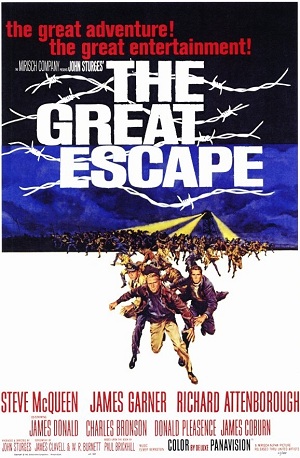
The Great Escape (1963)

"They are the common enemies of anyone who believes in freedom. If the high command didn’t believe in Hitler, why didn’t they throw him out?”

This is, of course, a classic and I trust we’ve all seen it. It’s the gold standard of prisoner of war films,  with a magnificent story, all-star cast and brilliant pacing and direction. It’s a superb action film that keeps you gripped for a full two hours and forty-eight minutes.

But it is, perhaps, more than that. Interestingly, it’s a study in fanaticism, but suggests that in extreme cases- against Nazi Germany- fanaticism is justified. The human cost of the escape is huge, with the slaughter of the fifty. And yet, with the sheer damage to the German war effort, it is worth it. Roger (a superb Dickie Attenborough) is a thoroughgoing fanatic, but he’s right, and is allowed a happy death. And he’s right in the quote above; the Luftwaffe may not be the SS and Gestapo, and the Kommandant may be visibly uncomfortable with Nazism, but he’s still working for Nazi Germany and is the enemy.

The human cost isn’t just shown via numbers in terms of the fifty, though; we get to see Ives crack up after months in the cooler and get himself shot, all after the only day of fun the prisoners have had for months. This film may be entertaining mainly because of the mechanics of the escape, but the human cost is shown and. characterisation is very believable.

Ultimately, though, it’s how the plan is carried out that entertains you as much as quirky characters like Hilts, Colin, Mac, Hendley, Danny and many more. The film takes its time to show us the ups and downs of the escape plan, getting us to know the characters in the meantime. And, at the end, we’re overjoyed to see that at least some of them made it.

Yes, I know: the historical accuracy is a bit pants. But war films don’t get much better than this.