Showing posts with label 1963. Show all posts

Sunday, 26 October 2025

The Haunting (1963)

 "It was an evil house from the beginning- a house that was born bad!"

This may be the quintessential, the perfect haunted house movie. It's also a serious contender for the best and most terrifying horror movie ever made.

It won't satisfy fans of gore, of course. The fear is abstract and unseen, just sound and subtle but terrifying hints of something malevolent in this house with a long, evil past. The horror is conveyed by the performances and, especially, by the extraordinary direction of Robert Wise: few things in this world are more terrifying than the use of the camera in this film. And there's a nicely metatextual touch in that part of what makes the house so unnerving is the unnatural angles, a nice little nod to German Expressionism.

Yet, as with many such horror films, the focus is on one tragic young woman, Eleanor- naive, of limited horizons, spending her whole adulthood caring for her controlling mother in a dysfunctional family. No wonder she's attracted to the calm, urbane Dr Markway. He, on the other hand, seems to represent the veneer that is civilisation, which likes to think it is in control of the forces that truly shape everything... 

There's a lot going on here, thematically, behind the horror. Eleanor's background is complex, tragic and shown to us without didacticism. Yet it seems to me that, ultimately, the film is about the cycle of abuse, a truly terrible thing. This is a truly great film.

A couple of interesting points, mind. I was surprised to see the diminutive "Nell" for "Eleanor" used as late as 1963; it feels much more archaic than that, being a contraction of "Mine Eleanor". And then there's the dialogue about creepy statues moving when one isn't looking at them.. don't blink!


Saturday, 18 October 2025

The Haunted Palace (1963)

 "One becomes accustomed to the darkness here."

Not many films have been made adapting the works of H.P. Lovecraft, writer of cult horror stories evoking the nameless, ancient horrors that lurk behind everyday reality... and, er, massive racist, by the standards of his own time, let alone ours. Imagine my surprise, then, that this- the first ever cinematic adaptation of a Lovecraft tale (his only full novel, The Case of Charles Dexter Ward)exists... and was helmed by Roger Corman himself in the style of the Poe films he was also busy making. 

Naturally, the title is pinched from Poe, we end with some verses from Poe, and the style absolutely evokes the Poe films, with Lovecraft very much downplayed. Yet this is, nevertheless, full-on Lovecraft, full of delightfully overwrought existential dread, and explicit mentions of not only the Necronomicon and the Great Old Ones but specifically of Cthulhu and Yog-Sothoth.

And it's really rather splendid, with Vincent Price hugely entertaining as both the eponymous Ward and his depraved warlock of an ancestor. We have unspeakable horrors from the past; unfriendly locals in a tavern aside from one scientifically minded individual; "satanic" rituals"; disturbing body horror with the mutated locals (particularly the girl born with no eyes!) and a perfectly paced horror movie that ends up feeling very similar indeed to Corman's Poe films.

There is an extremely uncomfortable scene featuring attempted marital rape, which is not exactly the right kind of disturbing. But there are angry villagers with torches. There's a snake and a tarantula. There'sa creepy old portrait with terrifying eyes. And the whole things just so damned entertaining.

Saturday, 14 December 2024

The Pink Panther (1963)

 "You do the walking and I'll do the drinking."

Yes, I know, forty-seven and have only just seen this... 

Anyway, it's fascinating to see the actual film behind the Pink Panther cartoon and that seminal Henry Mancini tune that we all know so well; these things in themselves are a seminal achievement, as is the opening titles. It's all very well shot. But... well, asa comedy, it's a curate's egg.

Of course, as with the original curate's egg, parts of it are excellent. This isn't a comedy of verbal jokes, exactly, but the script is particularly witty in its sexually charged conversations between David Niven's Sir Charles (and his nephew George to some extent) and both Simone Clouseau and the Princess. This is top quality flirting and there's a lot of it.

Plus the setting- the Swiss Alps and Rome- is visually arresting, and the plot is enormous fun. But, well... we need to talk about Inspector Clouseau. I mean, Peter Sellers plays the part very well, and it's not that I don't enjoy slapstick comedy or farce. But the character isn't that funny. Oh, I do enjoy the extended sequence in the hotel room with Simon where both Sir Charles and George hide from him. But all the falling over and bumping into things just gets tired very quickly.

Still, a film doesn't have to be the greatest ever example of its genre to be good. This is no Life of Brian, but it is, at least, quite funny, and the flirting scenes are genuinely brilliant. Iwasn't blown away... but I enjoyed the film. And that's what matters.

Sunday, 12 November 2023

Dementia 13 (1963)

 "Drink's the only road to survival in this climate."

No, I have no idea what the title means either. This is, however, a delightful little gem from a young, creative Francis Ford Coppola. With very little budget, he relies on directorial flair, plus the fact that monochrome hides all sorts of budgetary sins, to produce a rather special little film.

Spoilers. Be warned.

The misdirection is nicely done: we think we're watching a ghost story, but it turns out we're watching an early slasher movie-cum-whodunit. The script plays very nicely indeed with genre tropes: Patrick Magee has a wonderful scene towards the end where he tries to persuade the just-married Kane that yes, his mannerisms are very sinister, but he's actually the red herring, honest. And, of course, it is he who eventually saves her from the killer.

The location is nicely evocative: an old castle in Dev's Republic of Ireland where an aristocratric family struggle in adapting their gothic values to this new world where all of the late Lord Halloran's sons are now devoid of titles and thoroughly Americanised.

Visually and conceptually, the whole thing is superb- the scene where Louise finds the creepy dolls; her death by the pond; the dark humour of the opening scene as Louise's dying husband gloats that his fatal heart attack means she will inherit nothing. Coppola will go on to direct more serious films, but this is a B movie done with real class.

Saturday, 9 September 2023

Carry On Cabby (1963)

 "She's taking a man's job."

Some Carry On films I've seen in my slow marathon through the lot of them, in order, have been better than others. But none of them have been actively bad. Until now.

The film is notable, I suppose, for the Carry On debut of Jim Dale in a fairly small but very noticeable role. Kenneth Williams is missed, but this isn't the first time he's been absent. No: what's fundamentally wrong is the script or, more fundamentally, the concept.

Sid James' character Charlie is a workaholic who works such long hours he badly neglects his wife Peg, played with aplomb by Hattie Jacques. So she sets up her own all-female cab firm in competition to teach him a lesson. There's comedy here... but there's also a lot of very real emotion. The tone is all over the place and the very real marital tension at the heart of the film both stops this feeling like a Carry On film. The mood just isn't right, however amusing the set pieces may be.

Also, Charles Hawtrey is shown lusting after women and even says "phwoooar" at one point. Er, this just doesn't work.

Some of the social attitudes shown are... interesting. The sexual politics, obviously. An odd undercurrent of almost prudery from the characters at times. The trade union stuff. The attitudes to sexual harassment. And the concluding scenes where Charlie is shown drunk but then gets into his taxi to save the day. Yeah. It was a different time. 

The film, however, just isn't any good. Unless you're making a point of watching the whole series, as I am, this one is eminently skippable.

Saturday, 1 October 2022

The Raven (1963)

 "But you'd be kiled!"

"I do hope not..."

I haven't checked how many of Roger Corman's Poe films I've seen. It's a lot. It's possible, with this film, I've seen them all. 

They are, of course, all B movies, bless them. They all acknowledge the fun side of that. Corman has always understood the power of kitsch... except in Frankenstein Unbound. This film makes me wonder if the tongue in cheek subtletiesof his other Poe films are wittier than they come across, Because this film is full of ironic, fourth wall- threatenning humour.

Understandably, many films are based on novels or plays. Few films are based on poems, yet this film begins with a recital of Poe's masterpiece- I love the poem, unfashionable thought it is; compare it to the adolescent nature-wanking drivel of John Keats- and just has fun.

Vincent Price is a great avtor, one who deserved more than B movies. Here he shows his prowess at deadpan humour. Peter Lorre not so much, but you can't take your eyes off him Hazel Court is more of the classy straight actress, but her performance works very well indeed. Boris Karloff cannot fail to be the consummate evil sorcerer. He was born to play such a role.

Yet Jack Nicholson- yes, he was once this young- turns out to be a bloody good comic actor, moving beyond the point of treating B movie characters like Shakespeare, as he was previously known to do, and showing a real comic timing. 

This film is a joy, despite the tenuous connection to Poe, and the cast is fascinating. So is the deliciosly garish direction, exalting in the possibility of Technicolor.

I know this film is very silly, but I love it.

Saturday, 20 March 2021

The Kiss of the Vampire (1963)

 "Made by grapes trampled by the feet of a peasant..."

Another Hammer. Why not? 

This isn't a well-known film, particularly. It has no stars, and makes do with Edward de Souza as leading man. It is essentially a collection of set pieces based around predictable horror film tropes which gradually reveas itself as a neighbourhood which exists to trap visting couples into surrendering the female of the pair, as a kind of droit de seigneur siruation, to the local lord, who happens to be a sexually magnetic vampire in the mould of Dracula- an aspect many films miss.

The tropes come thick and fast- the coupe, in their charming Edwardian roadster, break down in a sinister rutal area where the only buildings are sinister-looking edifices. The only local hoteliers are extremely sinister and mysterious. A bearded figure warns them to leave the area and ask no questions. This is a great film for horror film tropes bingo.

The twist is clever, though; the whole set-up is a cuning trap, and I love the scene where Gerald is gaslighted into believing, or nearly believing, that there never was a fancy dress ball (another trope), and that he came alone, without his wife. Gerald, an Englishman finding his wife seduced by some dastardly Mittel European foreigner, is fortunate to find that the bearded bloke is a kind of Van Helsing archetype, so they're able to defeat the vampire lord and his comical cult- with a chalk circle and vampire bats, naturally.

This film is delightfully bonkers.

Saturday, 13 March 2021

Black Sabbath (1963)

 "I do hope you haven't come alone..."

What is this that stands before me? Figure in black that points at me? Well, no, it's Mario Bava's most famous film, a highlight of Boris Karloff's career and, of course, famously seen at the cinema by one Geezer Butler.

It's also an extraordinarily shot film, wit studio and location made to look creepily effective by means of camera framing, movement and a thoughtful deployment of a colour palette based around magenta and green. This is a film that plays around, and has fun with, the concept of what is a horror B movie and what is a more serious film, and deliberately blurs the distinction. It's a portmanteau film based on short stories by such names as Chekhov, Tolstoy and Maupassant, yet the script cheerfully diverges from the source material in the pursuit of the grand guignol, artistically depicted.

The three tales are each very different, with effective twists, but all have in common the very effective use of tension- as well as the use of the camera to make elements that may look cheap or ineffective in the hands of a lesser director look terrifying. The first tale has overtones of male violence against women, yet is told from a female perspective (and gaze), while the second tale, with Karloff truly oustanding, is a clever take on the vampire myth, moving it to a creepy rutal Russia of Czernobog gloom. The third tale may be the slightest, but it perfectly illustrates how much Bava can do, even with relatively basic material, to wring the maximum amount of effectively paced and creepily shot horror out of whatever he's given with.

An impressive film but although, yes, Karloff is ecelent, essentially this is an example of a film raised from the ordinary to the extraordinary by superb direction. Bava is magnificent.

Saturday, 6 March 2021

Diary of a Madman (1963)

 "Considering your endless studies of the criminal mind..."

You know when you start watching a film expecting a B movie, despite the literary basis of the script, and end up with a phiolosophical, literate and genuinely creepy little horror film? This is one of those nights. I don't care that the critics don't care for this film: they're wrong.

Obviously, Vincent Price, with that voice, is charismatic, extraordinary, and carries the film through sheer presence. But that's a given. Plus, the film and, indeed, the director, are fairly obscure. Perhaps what I'm truly blown away by is the original story (or two stories) by Guy de Maupassant- I've never read his short stories and, unlike other French authors, he isn't widely read in the English-speaking world. Yet I read that considerable liberties were taken with the source material beyond just conflating the two stories.

Nancy Kovack is excellent, of course, as a woman we are made to see as evil for her love of money and pleasure, but what options did a woman have in the France of 1886 beyond gold-digging? There's quite a feminist critique to be made of this fim, methinks.

Neverthleless, it's a thoughtful and deeply psychological approach to horroe which not only focuses on well-rounded characters but roots the horror in those very character traits. The nature of the "Horla" (why that name?) may be vague, but its effects are not.

All this, and we get a milieu of the (very) Hollywood version of the Paris of the artistic era of Henri de Toulouse-Lautrec and so forth. I recommend this film really rather highly indeed.

Sunday, 28 October 2018

The Birds (1963)

" I have never known birds of different species to flock together. The very concept is unimaginable. Why, if that happened, we wouldn't stand a chance. How could we possibly hope to fight them?"

This is probably the last film I'll be blogging before Hallowe'en. I wanted to do a horror film and considered all sorts- there were all sorts of more obvious candidates, but this film seemed irresistible. And it was the right choice.

I'd like to start with how I just don't care that the bird effects are sometimes dated and not quite right; it was 1963,the film is sufficiently well made to render it a minor issue (it's Hitchcock), and it works in context. But this film makes birds terrifying, and makes you fear that they will, indeed, all gang up together, attack you and peck out your eyes. It’s also a fascinating early ‘69s artefact in which everyone is Mr This or Mrs That, men wear hats and indeed suits for dinner at weekends, and there are all sorts of small “c” conservative indicators yet you just know that none of these people are so moronic as to have voted for that orange wanker. Sigh.

It’s a horror film through and through, with birds terrorising a Californian seaside town gradually but totally. Wonderfully, it offers no explanation of why birds have suddenly attacked humans, but it hints at a bleak, perhaps apocalyptic future while leaving the wider world building to our imagination, focusing on Melanie and her obsession with the handsome but rude Mitch and his interestingly characterised family. The main characters are all compelling and, indeed, the early scenes, very Hitchcock-like, appear to be pointing towards a screwball comedy, with the first scene being blatant romantic farce. But Hitchcock tends to play with genre tropes and then change path, which he does here with perfection.

Tippi Hedren is superb, yes, as is the entire cast. But the real star here is Hitchcock as he once again breaks new ground. Suspense, real horror, perfect for this fiendish season.

Thursday, 9 November 2017

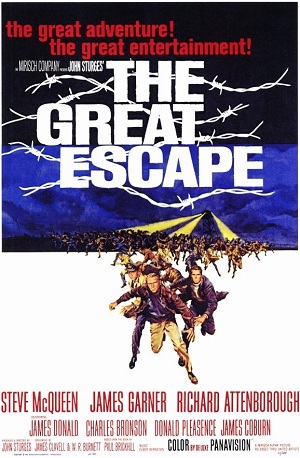
The Great Escape (1963)

"They are the common enemies of anyone who believes in freedom. If the high command didn’t believe in Hitler, why didn’t they throw him out?”

This is, of course, a classic and I trust we’ve all seen it. It’s the gold standard of prisoner of war films,  with a magnificent story, all-star cast and brilliant pacing and direction. It’s a superb action film that keeps you gripped for a full two hours and forty-eight minutes.

But it is, perhaps, more than that. Interestingly, it’s a study in fanaticism, but suggests that in extreme cases- against Nazi Germany- fanaticism is justified. The human cost of the escape is huge, with the slaughter of the fifty. And yet, with the sheer damage to the German war effort, it is worth it. Roger (a superb Dickie Attenborough) is a thoroughgoing fanatic, but he’s right, and is allowed a happy death. And he’s right in the quote above; the Luftwaffe may not be the SS and Gestapo, and the Kommandant may be visibly uncomfortable with Nazism, but he’s still working for Nazi Germany and is the enemy.

The human cost isn’t just shown via numbers in terms of the fifty, though; we get to see Ives crack up after months in the cooler and get himself shot, all after the only day of fun the prisoners have had for months. This film may be entertaining mainly because of the mechanics of the escape, but the human cost is shown and. characterisation is very believable.

Ultimately, though, it’s how the plan is carried out that entertains you as much as quirky characters like Hilts, Colin, Mac, Hendley, Danny and many more. The film takes its time to show us the ups and downs of the escape plan, getting us to know the characters in the meantime. And, at the end, we’re overjoyed to see that at least some of them made it.

Yes, I know: the historical accuracy is a bit pants. But war films don’t get much better than this.

Saturday, 2 September 2017

The Terror (1963)

"Mark you, you are getting yourself into things beyond your understanding!"

Roger Corman, O Roger Corman, you have your tropes. I mean, this film isn't even based on a Poe story but it might as well be. It's all typically gothic, set in "the remains of a noble house" and full of the sinister suggestion that the sins of the past may come to find us. Oh, and we have Boris Karloff and Jack Nicholson in the same film, a witch, a bloke getting his eyes pecked out by a bird, and Nicholson being delightfully excessive throughout in really trying to find motivation in the cipher of a character he's playing; he actually manages to imbue his shitty lines with some depth. Wow.

But let's not be too harsh; this is a fun film and exactly what you'd expect from Corman. It's a precious artifact from those last few years of Boris Karloff's life in which he was again fashionable, and both he and Nicholson are excellent in a competent film, if a cheap one and formulaic in the best possible way. This is pure distilled Corman, with two excellent performances from its leads, so much so that we can avoid the unfortunate continuity error about when Ilsa is supposed to have died, and the frankly implausible twist about the Baron that comes at the end. What counts is atmosphere, and Karloff, and Nicholson. Typical Corman in the best possible way.

Monday, 11 January 2016

From Russia with Love (1963)

"Red wine with fish- that should have told me something!"

Two films in and we still haven't quite hit the formula as it would be. There's another perfect, fully-formed Bond villain- a cat-stroking head of SPECTRE whose face is unseen and who is, as yet, unnamed- and this time there's a rather extensive gadget, handed to Bond by Major Boothroyd of Q branch (not "Q"), this time played by Desmond Llewelyn. It's early days still, though: it's 1963, and in the final sequences Bond even wears a hat.

It's a good film though, making the most if it's glamorous Istanbul location with a set piece in the Hagia Sophia, although this contrasts somewhat with the cramped surroundings of the Orient Express.

The film is again carried by the remarkable Sean Connery, although another acting highlight is the rare appearance of George Pastell in a film not featuring Egyptian mummies. Pedro Armendariz gives us a likeable, worldly-wise Karim Bey, although it's obvious from an early stage that he's going to die. Such is the rhythm of films like this.

Daniela Bianchi is a rather passive and restrained Bond girl; that's a tradition which had still to evolve. At this point the films are still reasonably faithful adaptations of the novels, even to the absurd point of the clearly Scottish Bond being referred to as an "English gentleman. It is again, though, a bloody entertaining film.

Thursday, 15 October 2015

Jason and the Argonauts (1963)

"The gods of Greece are cruel! In time, all men shall learn to live without them."

This film looks great with its location filming, is a rollicking adventure story, and has a mostly good cast with Honor Blackman as Hera and an outstanding Patrick Troughton as Phineas, although the casting of a middle-aged and weedy-looking Nigel Green as Hercules is somewhat odd. Still, not many films have a special effects person as executive producer: this film is all about the one and only Ray Harryhausen and his stop motion animation, awesome here as always. Everything else is just window dressing, and rightly so.

So we get, at the climax, both a hydra and a phalanx of skeletons. We get a huge statue coming to life and picking up the Argo. We get two winged harpies. These are what the film is about, and they look amazing, far better than modern CGI. And if the myth is amended a little to accommodate all this, then so be it. This is why the film is worth watching.

I'm also pleased to see the inclusion of the gods at Mount Olympus, though: too many films based on Greek myths omit them. This isn't a film that claims to be more than a simple adventure, but it's a pleasingly accurate portrayal of the spirit of the Greek myths and a highly entertaining way to spend an hour or two.

Sunday, 11 October 2015

8½ (1963)

"A writer's block? What if it's not just temporary, my friend? What if it's the final downfall of a liar who has run out of talent."

A single viewing probably isn't enough for me to properly discuss Federico Fellini's magnum opus. Suffice to say it's a beautifully shot and profoundly eloquent film, every shot pregnant with far more meaning than I can adequately discuss here. It's magnificent but, while it is everything I just said, it is by no means a "difficult" film to watch. There is a straightforward narrative in spite of everything.

Guido is a forty-three year old film director, like Fellini himself, and the assumption must be that the character is a self-portrait. This is interesting, as the character suffers from a profound writers block which he cannot overcome, ultimately leading, after much angst, to an expensive, abandoned failure. This is, of course, the underlying anxiety of all artists. But there is, I think, more, an ennui and existential angst, mixed with mid-life crisis, that seems very appropriate to the early '60s.

I wonder if Fellini has a similar difficult relationship with his wife? And, of so, if her reaction to the film on seeing it was the same as the fictional Luisa?

There are many dream sequences (one of which involves a harem of showgirls, and a whip!), all of which are deliberately shot so as not to be straightforwardly separated from the main narrative. Delightfully metatextual games are also played: I love the character of the critic. Not only does Fellini get to use the character to anticipate any and all criticism but he skewers the worst sort of critic quite delightfully.

Not exactly light viewing, this, but extremely rewarding. I recommend it hugely.