Showing posts with label Donald Pleasance. Show all posts

Friday, 5 May 2023

The Devil's Men (1976)

 "I beliewve the Devil has taken possession of this village!"

There was, around 1976-ish, a sudden craze for movies about robed devil worshippers sacrificing groovy youngsters in stone crypts, of which this is one. It's of it's time; the youngsters of 1976 may have considered themselves as hip and groovy, but punk was coming along to give them a good slap. 1976 was forty-seven years ago, as 1919 was to them. In some ways they were modern, yes, but the women shopped and cooked, and were slapped when, ahem, hysterical. It was a long time ago. It was the year I was conceived.

This is, I suppose, a silly B movie by a Greek director shot on sumptuous location saturated with visual culture, with Peter Cushing and Donald Pleasance imported for star power. The critics, it seems dislike it. Yet, accepting the fiulm for what it is, it's an enjoyable romp, full of lots of little cultural nuggets that become apparent, even in a B movie, after so many decades.

This is an X rated movie. There are boobs. There is Satanism. There is Kensington gore. Yet the hero is a friendly, likeable, boozy Catholic priest- played by a Donald Pleasance who will never be square jawed but is a hero more than one might expect- who gets to save the day with exorcism. The Pope would almost like this film. If not for, you know, the naked ladies and the fornication.

This film is a load of old tosh in the best possible way. It's on Netflix. Watch it. I advise a bottle of wine.

Saturday, 31 October 2020

Halloween (1978)

 “You can't kill the Boogeyman!"


At last I find a subtitled version. Hooray. It's about time.

This is, as I kept saying about the early Friday the 13th fims, an absolutely textbook slasher movie, and one of those films which played a big part in setting up the tropes we all know- sex, saying "I'll be right back" and smoking weed (while driving, tut tut) are all hazardous for one's life expectancy although, if you're over twenty, you'll probably be all right.

What separates Halloween from these films is, quite simply, it's much better directed by the splendid John Carpenter and, indeed, much better made. What's different here, as shown in the superb camerawork, music and use of the pumpkin motif, is that this is the first slasher since Psycho that isn't a B movie.It may be a straight-down-the-line slasher, but it's done really well, with the dialogue and acting a cut above what we's expect from the genre. It's slow, and the killing doesn't start until fairly late on, but there's excellent use of suspense, with Michael Myers being glimpsed everywhere.

A very young Jamie Lee Curtis heads a very young cast, while Donald Pleasance is a rather astute piece of casting for Dr Loomis. It's rather jolting seeing him play an American, though, and his accent lapses on occasion. It's interesting, too, to see the use, and meta-commentart, of the 1951 version of The Thing from Another World (must see that at some point) on the telly, given what Carpenter would proceed to shoot a couple of films down the line.

It's a textbook slasher, but it's the textbook slasher, impressing even someone so jaded with the genre as myself.

Saturday, 15 February 2020

Dracula (1979)

“Oh, I loved to be frightened..”

This was the last of the famous Dracula films I’d seen and, while it doesn’t rival the recent BBC TV series, it’s easily the best cinematic version of the original novel, excellent though some of the others have been.

This film is, strictly speaking, based on the play written in the years after the novel was published but, despite skipping the famous Transylvanian bit, and with those inevitable lines "I never drink wine" and "Children of the night, what (sad music they make" present and correct, this is broadly very faithful to the original epistolary novel- not without changes but preserving the core of the story, namely Dracula coming through the window to threaten first Mina and then Lucy.

There's no downplaying the original sexual subtext of Dracula drinking Lucy's blood, either: the film is very well-shot throughout but the main scene of Dracula feeding from Lucy is directed in an abstract but obviously sexual way. Plus, of course, Frank Langella gices us a charming and deeply erotic version of the Count, with charisma enough almost to rival the great Christopher Lee.


Laurence Olivier is, perhaps, hamming it up as Van Helsing, although Larry hamming it up is worth a strong performance from a lesser actor. But it's a real stroke of genius to cast Trevor Eve as an appropriately chippy Jonathan Harker, somewhat pissed off at Dracula for nicking his fiancee.

It's also nice to hear Hollywood acknowledging that Whitby is in face in Yorkshire and not the Home Counties, with the not-posh characters having accents to match. It's a nice but crucial detail that is so often forgotten. It may or may not be the best Dracula film, but it's easily the best cinematic version of the novel Bram Stoker wrote.

Saturday, 23 November 2019

Phenomena (1985)

“People call it the Swiss Transylvania...”

This is, to my shame, the first film by Dario Argento that I’ve seen. This film isn’t perhaps quite as good as the critics say, but it certainly isn’t the last of his films I’ll be Seinfeld. It’s very well shot, stylish and pleasingly weird, if a little slow.

This is a slasher, sort of, in a very ‘80s style yet a cut above visually with a more artistic approach than you might expect from the genre- as well as an interestingly prog and metal soundtrack with a central role for Iron Maiden. In many ways, I suppose, this is a vaguely European Friday the 13th- in terms of plot as well as style- but it’s much, much better made without escaping its genre.

It’s odd to see such a very Italian film in English, and to see its stars- a fifteen year old Jennifer Connelly and a late period performance by the great Donald Pleasance who, it must be said, does not have the most convincing Scottish accent.

It’s all very much of it’s time with the fashion, music, and cars, and visually it’s always made both with an artistic, dreamlike vision and the uneasily creepy grammar of horror film visuals. It is, at times, guilty of a slowness of pace caused by lingering arty camerawork, but the film works narratively and the final twist, although predictable to the genre-savvy, is well done.

This is, I suspect, a fairly average example of Argento’s work, but on the whole I enjoyed it. I’ll certainly be seeing more.

Sunday, 30 June 2019

Circus of Horrors (1960)

"Quick, get her to a doctor. And send the clowns in."

This is a mildly obscure but well regarded non-Hammer horror film, one with no supernatural elements and more tension than scares, although the sheer body horror of the opening scene with Evelyn’s face after her plastic surgery disaster, along with her hysterical laughter, is one of the most disturbing scenes I’ve ever seen.

Anton Diffring is rather good as our plastic surgeon anti-hero, improbably fleeing to the continent and setting up as a circus after reshaping the face of poor little Nicole and the untimely death of her father who, bizarrely, is Donald Pleasance with a French accent. And so a situation evolves where a circus is set up starring wanted and highly blackmailable criminals whose faces have been reshaped, but dastardly Rossiter has all the details. I’m not sure how such a circus should have become successful from its poor beginnings, but let’s roll with it. Let us also roll with the fact that circuses in 1960 were rather cruel places, with lions, bears, elephants, horses and gorillas cruelly whipped and forced to perform to a clapping and unbothered crowd. People in 1960 also seemed to Thing that clowns were funny and not terrifying at all. Weird.

Of course, every now and then a glamorous female artists threatens to leave the circus, and coincidentally ends up suffering a freak fatal accident in her final performance, something which has not gone unnoticed by the authorities. Amusingly, several times we see said artistes declaring that they will leave or reveal something after the final performance, which they always approach without any fear whatsoever. But this means plenty of tension, and in spite of the awkward questions about the plot this is a rather compelling film and a cut above most of its ilk.

Saturday, 15 September 2018

Fantastic Voyage (1966)

"The antibodies will attack as if she were bacteria!"

This is a very silly film, played incredibly straight and, what’s even weirder, what looks and acts like a sci-fi B Movie is helmed by a proper Hollywood director and seemingly lavished with cash..

The performances are a cut above what you can expect from a B movie, with Donald Pleasance standing out as (spoilers) the baddie. We sort of know we’re not supposed to like Dr Michaels when he suggests that the wonders of the human body may have arisen through evolution, as confirmed many times over by empirical observation, as opposed to being a literal “miracle”.

The whole thing is surprisingly focused, with very little framing device; with the minimum of fuss a team is put into a submarine, shrunk and injected into the bloodstream of the ill man who absolutely must be cured because plot reasons. It begins quickly, ends abruptly and consists of various perils from the human body in-betweeen, with the realisation of the bloodstream, the heart and various organs being actually pretty impressive. Meanwhile there’s a bunch of fretting military types watching their progress, in scenes that must surely have inspired Airplane!

It’s all very ‘60s spy film, sent in the present day in a large government facility with massive corridors that looks like a Bond villain hideout, complete with those cool little cars. There’s only one token woman, of course, and she’s an assistant. And, er, Raquel Welch is playing a character called Cora. Yes, Cora.

But what’s extraordinary about this film is, firstly, that it actually looks pretty damn good and gets away visually with the premise, but mainly in the way it carries out the Lost art of doing something very, very silly with absolute seriousness. They don’t make them like this any more...

Thursday, 9 November 2017

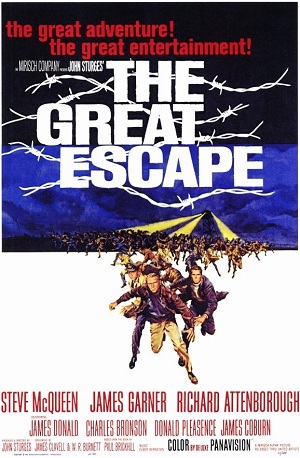
The Great Escape (1963)

"They are the common enemies of anyone who believes in freedom. If the high command didn’t believe in Hitler, why didn’t they throw him out?”

This is, of course, a classic and I trust we’ve all seen it. It’s the gold standard of prisoner of war films,  with a magnificent story, all-star cast and brilliant pacing and direction. It’s a superb action film that keeps you gripped for a full two hours and forty-eight minutes.

But it is, perhaps, more than that. Interestingly, it’s a study in fanaticism, but suggests that in extreme cases- against Nazi Germany- fanaticism is justified. The human cost of the escape is huge, with the slaughter of the fifty. And yet, with the sheer damage to the German war effort, it is worth it. Roger (a superb Dickie Attenborough) is a thoroughgoing fanatic, but he’s right, and is allowed a happy death. And he’s right in the quote above; the Luftwaffe may not be the SS and Gestapo, and the Kommandant may be visibly uncomfortable with Nazism, but he’s still working for Nazi Germany and is the enemy.

The human cost isn’t just shown via numbers in terms of the fifty, though; we get to see Ives crack up after months in the cooler and get himself shot, all after the only day of fun the prisoners have had for months. This film may be entertaining mainly because of the mechanics of the escape, but the human cost is shown and. characterisation is very believable.

Ultimately, though, it’s how the plan is carried out that entertains you as much as quirky characters like Hilts, Colin, Mac, Hendley, Danny and many more. The film takes its time to show us the ups and downs of the escape plan, getting us to know the characters in the meantime. And, at the end, we’re overjoyed to see that at least some of them made it.

Yes, I know: the historical accuracy is a bit pants. But war films don’t get much better than this.

Tuesday, 9 February 2016

You Only Live Twice (1967)

"Well, at least he died on the job..."

Well, it's quite the contrast. Thunderball was a pile of pants, an incoherently directed film with little in the way of charm or entertainment, whereas You Only Live Twice is superb, and easily the best Bond film so far. What went right? Well, the straightforward direction by Lewis Gilbert helps; Thunderball may be much artier (It has wipes, for Christ's sake! In a James Bond film), but it fails to make the narrative clear. Here we have no such problems. What we do have is a well constructed and paced film courtesy of a script by the great Roald Dahl. Yes, that Roald Dahl.

Even the opening sequence is innovative-the image of a NASA space capsule being eaten by another spacecraft is delicious, as is Bond's apparent death before the titles. And the image of a spacewalking astronaut drifting helplessly through space to what he knows will be his death has all the existential horror of the late David Bowie's "Space Oddity" a couple of years later.  All this before we even get to the theme song from Nancy Sinatra, who gives the great Shirley Bassey a run for her money.

We then move straight to the Americans blaming the Soviets for the swallowing of the spacecraft, with both of them portrayed as squabbling juvenile warmongers, leaving the British (naturally) as the voice of reason. This is a little uncomfortable to watch from a distance of fifty years, however. In the wake of Dean Acheson's famous comment Britain is being portrayed here as a "Greece to America's Rome", which smacks very much as a consolation prize for a wannabe superpower. Even this film, which portrays the clever British as in control and saving the world, can't hide the fact that the Americans and Russians of 1967 are sending people into space and we are not.

The fact that M and Moneypenny are in a submarine is brilliant, as is the recognition of Bond's naval rank. The two superpowers are at loggerheads and world war beckons if all this is not sorted out before the next spacecraft is launched. Fortunately, there's a lead pointing to Japan. Also fortunately, Bond took a First in Oriental Languages at Cambridge.

It's interesting that the film's inevitable misogyny (as ever, women are seen through the eyes of a fifteen year old boy) is somewhat obscured by the presentation of all this in the context of what Japanese culture is supposed to be like. There's also the question of ethnic stereotyping, and while this can't be dodged the film gives a broadly positive image of Japan, perhaps remarkably so less than a generation after the War. We get Sumo wrestling, geishas and, of course, ninjas. The tropes are all here to play.

Is impossible at this point not to mention the cute and willing Aki ("I think I will very much enjoy serving under you") who is killed, while Bond's initially more modest "wife" is not. Hmm. Still, this Japan is cool, and I love Tanaka.

The bit with "Little Nellie" looks suspiciously as if it was just crowbarred into the film to give Desmond Llewelyn something to do, but it isn't long before the Russians launch a rocket of their own (Norse pagans will be either pleased or outraged that the Russian for "three" is "Odin"), which is duly swallowed again. Cue more recriminations and a reminder of the stakes, although it certainly makes me wonder how credible it is that a criminal organisation like SMERSH could have the resources to send a rocket into space capable of doing this. Best to banish such thoughts.

This film is possibly the most influential Bond film in popular culture and certainly for Austin Powers: the volcano base is brilliant, and Donald Pleasance's splendidly hammy performance as the now-revealed Ernst Stavro Blofeld is blatantly the inspiration for Dr. Evil. And the piranhas, and the collapsible ramp above them, are perfect.

This is an incredible film and easily the best so far. I'm genuinely unsure if anything will top it.

Saturday, 14 January 2012

Nineteen Eighty-Four


“If you want a vision of the future, imagine a boot, stamping on a human face, forever.”

I should probably say at the start that this is the 1954 BBC teleplay, written by Nigel Kneale, directed by Rudolph Cartier and starring Peter Cushing. It’s rather interesting to see this for the first time just one week after seeing The Year of the Sex Olympics; suddenly the debt the later play, set in a future with a diminishing vocabulary, owes to Orwell’s concept of Newspeak becomes even more blatant.

This is first class telly, though. Yes, it’s of its time, with a rather blurry picture quality (although, to be fair, the prints could really do with a good clean), and technical limitations mean that a slow pace is sort of inevitable, but this is no bad thing. The cast is superb, with Peter Cushing putting in an outstanding performance, with honourable mentions also going top Yvonne Mitchell and André Morell. It’s quite a shock, too, to see Donald Pleasance in a television role. There’s also a nice little cameo from Wilfrid Brambell.

It’s not just the picture quality that dates this; it is, after all, the earliest piece of telly I’m likely to be reviewing on this blog except, probably, for the surviving bits of The Quatermass Experiment once I get to it. The fact that it was made live (apart from the many film sequence!) isn’t really too obvious, but lots of other things are, notably the plummy accents, Mr. Cholmondely-Warner strength, which are spoken by every character who isn’t a prole. And this is a future with things like valves in it It’s rather interesting, though, to see an adaptation made just five years after George Orwell’s novel was published; the general feel of austerity (how very topical!) seems very fitting, especially as 1954 was the year that rationing finally ended. I couldn’t help also noticing that, among the many sinister notices seen in the programme is one saying “Be ready to produce identity papers”. Orwell would have been horrified at the last Government’s plan to introduce identity cards, now thankfully off the table for now in a rare wise decision from our current lords and masters.

Cartier’s sets, with ever-present posters and pictures of Big Brother, are a triumph of design, and it’s a nice touch that everyone (except, again, the proles, who wear 1950’s clothes) wears what look very much like prison uniforms, while Winston Smith’s room looks awfully like a prison cell. This is a confining, utilitarian world, devoid of all beauty and ornament. The constant televised announcements, which cannot be switched off, remind me a lot of the 15 Million Merits episode of Black Mirror.

It’s a while, certainly more than fifteen years, since I last read the novel, so the sheer levels of totalitarianism on display here come as quite a shock. Big Brother is indeed watching everyone, even language itself is being perverted so as to render “thought crime” impossible, but the scenes towards the end, with Morell’s Obrien as the torturer, are more chilling still. The line asking how many fingers are being held up (blatantly ripped off / homaged, decades later, by Star Trek: The Next Generation), and the following dialogue, make it clear that the Party claims the right to dictate reality itself; there is no empirical truth. Rather cleverly, this is all foreshadowed by Smith’s job of “adjusting” past records to fit with current political convenience.

It’s interesting, although somewhat patronising, that hope lies with the uneducated and ignorant proles, and the fact that their cultural fare is all written or composed by computer could be read all sorts of ways. Hope certainly seems to be closed up elsewhere; even Smith is not quite the pure hero, agreeing to commit all sorts of awful crimes. But the romance between him and Julia is rather sweet and lovely, but also profound. What they have is theirs alone, and it’s real. Nothing else is. And their relationship burns all the brighter for the fact that it, and they, are doomed, and they both know it.

The ending, with both Julia and Winston denouncing each other under torture, is devastating, but brainwashing was very much in the zeitgeist so soon after the Korean War. This is a first class piece of telly, whether in terms of script, directing or performances, but I think its view of the future is a little pessimistic. Totalitarian regimes always have a limited life expectancy. They always burn themselves out eventually; the world is a chaotic place, for good or ill. The future will be far more Brave New World than Nineteen Eighty-Four.