Showing posts with label George Pastell. Show all posts

Friday, 8 April 2022

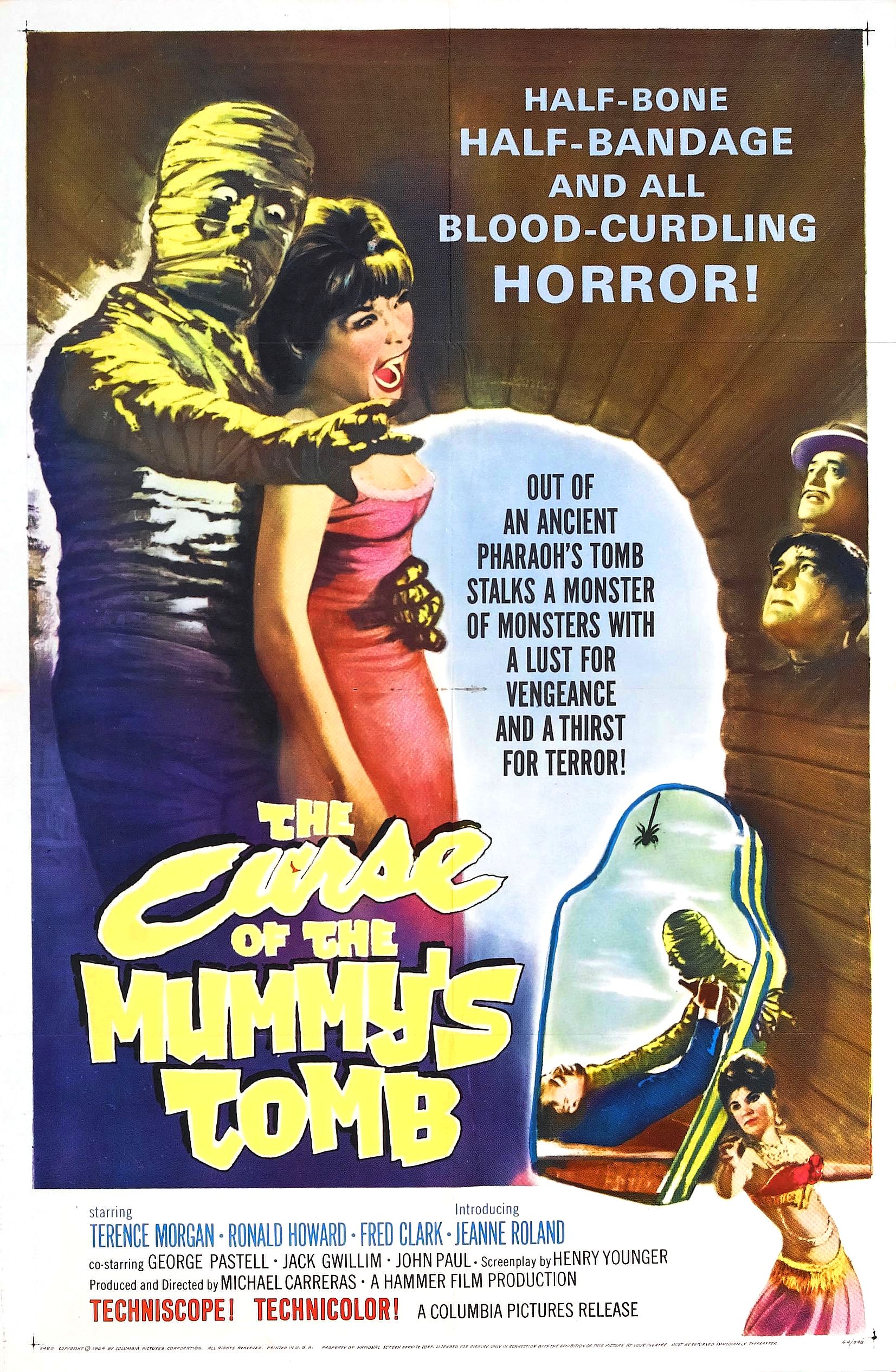
The Curse of the Mummy's Tomb (1964)

 "The public love to live dangeroiusly, as long as there's no real danger in it..."

Not every Hammer horror is a classic sadly. This isn't an awful film, and it looks gorgeous in places- the spectacle of the treasures from the toom, upon which we linger during the openimng titles, are so dsumptuous and impressibve we can very much forgive the obvious matte painted backgrounds in the obviously studio-bound desert scenes early on.

This is, I suppose, a fairly traditional mummy romp. The mummy looks good. The plot is decent, although one has to raise an eye at Adam's seduction technique of saying that an intelligent woman should not be a bluestocking but should instead use her intelligence to run a household and not worry her pretty little head over all that academic learning. Well then.

There's a very vulgar American stereotype, an ncultured P.T. Barnum wannabe. There's the inevitable George Pastell as a native Egyptian red herring, a man who proves to have noble intentions, even if his unexpected heroic sacrifice is shrouded in embarrassing stereotyping. 

Yet what stops this film quite catching fire, I think, is partluy that the cast, while generally competent, does not quite have the charisma that one would expect from such a film. There are no real stars and, while it's not necessarily a bad thing to cast character actors as leads, here it doesn't quite work. Everyone is competent onscreen but there is no magnetic screen presence.

Then there's the slow pacing in what is an awfully padded fim for one so short, and the fact we don't even see the mummy until far toolate. That said, though, the film is well made,and George Pastell is superb even if the stereotyped part he plays is not.

Monday, 11 January 2016

From Russia with Love (1963)

"Red wine with fish- that should have told me something!"

Two films in and we still haven't quite hit the formula as it would be. There's another perfect, fully-formed Bond villain- a cat-stroking head of SPECTRE whose face is unseen and who is, as yet, unnamed- and this time there's a rather extensive gadget, handed to Bond by Major Boothroyd of Q branch (not "Q"), this time played by Desmond Llewelyn. It's early days still, though: it's 1963, and in the final sequences Bond even wears a hat.

It's a good film though, making the most if it's glamorous Istanbul location with a set piece in the Hagia Sophia, although this contrasts somewhat with the cramped surroundings of the Orient Express.

The film is again carried by the remarkable Sean Connery, although another acting highlight is the rare appearance of George Pastell in a film not featuring Egyptian mummies. Pedro Armendariz gives us a likeable, worldly-wise Karim Bey, although it's obvious from an early stage that he's going to die. Such is the rhythm of films like this.

Daniela Bianchi is a rather passive and restrained Bond girl; that's a tradition which had still to evolve. At this point the films are still reasonably faithful adaptations of the novels, even to the absurd point of the clearly Scottish Bond being referred to as an "English gentleman. It is again, though, a bloody entertaining film.

Saturday, 13 August 2011

The Mummy (1959)


“He’s a foreigner!”

“Well, he can’t help that, poor chap.”

This will be my last Hammer horror film for a bit (there’ll be plenty more, but this blog needs a bit of variety- perhaps a Western next?). It already feels different, though; the specific areas in both Egypt and England (an area where all the working class people seem to be Irish) may be fictional, but this is a far cry from the vague Mittel-Europa settings we’ve seen thus far.

This is the first time I’ve seen a proper mummy movie, but it amuses me how many of the tropes I recognise from popular culture, and not least certain episodes of Doctor Who. It isn’t the best Hammer horror but it’s entertaining enough once it gets going. This takes some time, though. This is a no-frills journey through the standard tropes, played dead straight, sort of. Like other early Hammers, there’s definitely an element of camp ironic humour, but it’s as deadpan as deadpan can be.

We begin in colonial Egypt, in 1895. Archaeologist Stephen Banning, his brother Joseph, and John, his son with a gammy leg (Peter Cushing) have spent ages looking for the hidden tomb of Ananka, an ancient high priestess. An Egyptian chap in a fez (cool!) played by the splendid George Pastell delivers the sort of warning of dire consequences which are de rigeur for these sorts of films, but this doesn’t deter John. He enters the revealed tomb, and it’s completely undisturbed. The inside of the tomb, incidentally, looks magnificent.

It all happens very fast; we hear a scream, and suddenly we’re in England three years later. Stephen is in a mental institution, John has an even gammier leg and none of them seem remotely capable of going more than ten seconds without lighting a cigar or pouring a glass of whisky.

After years of being completely out of it, Stephen wakes up and warns John of “the mummy”. Other things are afoot, too; that Egyptian chap is nearby, and we discover that drinking and driving was rife in the 1890s. Tsk. This leads to their cargo, a mysterious Egyptian casket, falling into a conveniently placed swamp. This seems not to upset the Egyptian bloke, though. Look at his face. Is he bovvered?

Later, Egyptian bloke reads the scroll and brings the mummy to life. It’s rather muddy and visually engaging. It seems such a waste of Christopher Lee to just put him in bandages like this. Still, the following scene, a nice bit of exposition from John, quickly segues into an extended flashback where Christopher Lee gets to play Kharis, during life as an Egyptian priest, and not only gets a good few lines but ends up looking really rather cool. Still, it’s always a shock to see how small a role Lee tends to play in these early Hammers.

These scenes of Ananka’s death rites feature some genuinely horrifying scenes, and this is where the film starts to wake up. The scenes of the handmaidens calmly bowing their heads, awaiting decapitation and death so they can serve the princess in the afterlife, make quite an impression as the camera cuts away and instead we hear the swords strike. The horror grows as Kharis returns at night, blasphemously, to attempt the resurrection of the woman he secretly and illicitly loved. He is caught, and doomed to an awful fate. The scene where his tongue cut out is the most horrible thing I have ever seen- the camera cuts away as the sword hits the tongue, but the process up to this point is quite graphic.

Kharis is sentenced to be buried alive, ready to be brought back to life to avenge any desecration of his beloved’s tomb. And, the backstory now revealed, the mummy is sent forth by Egyptian Bloke to kill Uncle Joseph. John fails to stop him, but manages to let off a load of gunshots which, naturally, entirely fail to kill the mummy.

Then we get the really shocking bit: John casually admits to a police inspector (with an uncanny resemblance to Nicolas Sarkozy and an inexplicably North American accent) that he shot the murderer several times, and there’s absolutely no suggestion of any legal trouble whatsoever. Even more incredibly, he tells the inspector everything and, while the inspector is at least sceptical, you’re left with the impression that the police are extraordinarily deferential to country gents on Planet Hammer.

John knows the mummy is after him, though, and we’re not surprised to see the Egyptian Bloke send it to kill him. At this point John’s wife, Isobel, the only woman in the film, finally gets the first of what must be less than a dozen lines. The character is a complete doormat. John “orders” her to lock herself away while he waits for the mummy. It’s feminism gone mad.

Oh, and John’s wife is the very image of Ananka, it seems, and the mummy promptly buggers off for a bit. It there anyone who’s seen this film and didn’t immediately guess the entire rest of the plot at this point?

Conveniently, the inspector has been making enquiries which lead him now to believe John’s story. He tells John that under no circumstances whatsoever should he make contact with Egyptian Bloke so, naturally, he does exactly that. It seems his actual name is Mehemet Atkill, which sounds Turkish rather than Arabic, but never mind. It’s amusing to see John’s staggering lack of tact in scoffing at those who worship the god Karnak- in real life not a god at all but a temple complex near Thebes. I don’t think John realises that the man facing him worships this god; he’s just not very bright, is he?

Inevitably, Mehemet and the mummy come after John, but he’s expected. The mummy is about to kill John, but again he sees Isobel. When Mehemet tells him to kill Isobel, he is casually killed, and things start to go all King Kong as the mummy takes Isobel into the swamp. This is a bit of a weird love triangle- I wonder which of them Isobel prefers? Probably the mummy. I can’t imagine John would be much good in bed. Alas, he puts her down, and gets riddled with bullets.

It’s a film of two halves, really, this. But it’s probably short enough to be worth seeing.
Sunday, 7 June 2009

Doctor Who: Tomb of the Cybermen

Part One


"Perhaps we don't want your help."

"That's just it- you so obviously do."


Good Lord- a story that exists in its entirety, the first since The War Machines- such luxury! And probably the first story for ages I've encountered in the marathon that I know very well indeed. That means I'm thinking about what I'm seeing, not absorbing new info, so this review might go on a bit more than usual! Although the fact we get 100% footage may have something to do with it too.

It's such a difference watching this story in context. We start on Skaro, of course, and Victoria is introduced to the TARDIS in a scene I once considered throwaway but is a wonderful little character scene after seeing The Evil of the Daleks- Victoria's father and Maxtible get a nice mention, and the Doctor compares his time machine to Maxtible's.

So, the Doctor's 450 years old. This is our first inkling that he's of any great age, and after the last story only the second confirmation that he's an alien.

We're just bombarded with goodness- Cyril Shaps, some awesome incidental music, and a particularly well-sketched group of characters, nicely introduced. The structure of the story is great from the start, and there's something cinematic about both the look and the style of storytelling.

The one thing that bothers me about this story is there pretty much from the start though; the big, strong, practically mute servant type, always spoken about and seldom spoken to even in front of him, played by a black actor. This is an archetype from an earlier, less enlightened age.

In a story with few laughs, I had to chuckle at the revelation that the Cybermen have "dynasties". And also raise an eyebrow that, in the 25th (?) century, the women have to stay behind while the men explore!

Jamie states of the dormant Cybermat that "It's as dead as a stone". In no way is it going to prove a threat later then...

There's a lot to praise in this episode, but I'm particularly enjoying the verbal sparring between the Doctor and Klieg, well scripted and well acted by both troughton and George Pastell. And the Doctor's manipulating Klieg even from the first episode, of which more later.


Part Two


"You belong to us. You shall be like us."


I love Viner, both the character and Cyril Shaps' general magnificence. A minor character plot-wise but he adds so much to the story by voicing the audience's fears. And whilst ostensibly a comic character in some ways you never actually laugh at him; you know his tragic fate is inevitable and you sense that so does he.

Parry is in no way the leader of this expedition- it's the Doctor and Klieg who are competing for the alpha male slot here and the winner's never in any doubt. The character dynamics are very well developed as the plot progresses.

Kit Pedler's influence is clear in the technical stuff on symbolic logic and general lack of howlers, but rather surprising the excellence in plot and characterisation must presumably come from Gerry Davis, who's not previously impressed me much.

Oh look, food pills! I love these charmingly 60s sci-fi tropes. And the Cybermen's awakening scene, again to that music, is one of my favourite dramatic telly moments ever. It's awesome.

Up until the last story, it seemed as though character development had been a thing of the past, of the days of David Whitaker and Dennis Spooner. And yet, for the second story in succession, the Doctor continues his development into a more manipulative figure. The Doctor admits he allowed Klieg leeway with the controls just to see what he would do- and as a result Viner is killed! Surely the Doctor is partly to blame for this? In fact, surely Jamie should be pulling him up on this, especially after what happened last story?

It's interesting seeing the ritual by which the Cybermen awaken their Controller. They may have no emotions, but they seem to have cultural practices of a sort.


Part Three


"We're not like you!"


"You will be."


Interestingly, this story is a battle between three manipulators: Klieg, the Cybermen and the Doctor (in ascending order). Klieg's own serious pretensions to control of the situation are punctured at the very start of the story, while the Cybermen reveal their motivation more fully than before: they attacked the moonbase as their machines had failed and their extinction was nearing. Desperate to survive, they fled to the tombs.

Once again the terrifying prospect of Cybernisation is raised, and once again a first wave of Cybermen is beaten back halfway through the story. For the first time in a Cyber story, though, we're not blatantly being fed the same plot as The Tenth Planet, or at least it's being done sufficiently differently. I won't be marking the story down for excessive similarity to The Tenth Planet as I did The Moonbase.

The Cybermats are actually quite scary, although why they're called that I have no idea.

George Pastell shows what a fantastic actor he is, convincingly looking scared as Klieg knocks for the others to open the hatch and let him out. At this point Klieg is no longer at all in control, being manipulated by Kaftan. But even she is worried by his erratic behaviour,

The chat about bereavement between the Doctor and Victoria is a wonderful little scene, once again all the more so for seeing the story in context.


Part Four


"Well, now I know you're mad. I just wanted to make sure."


The final cliffhanger, with Klieg the threat, is appropriate as by this point, with the Cybermen safely below, he's the only potential cause of further danger. The threats posed by the Cybermen throughout this episode are all caused by him. This episode centres around the psychological battle for dominance between the Doctor and Klieg, but not without some other nice touches. Victoria is clever to feed the paranoia of Kaftan and Klieg with talk of "the other weapon". And I notice in the Doctor's scene with Toberman he tells him the Cybermen want to control him and make him their slave; this Doctor's dislike of slavery and control is becoming a definite character trait by now, as much as his interventionism and the hiding of his razor-sharp intellect behind the clownish exterior.

The Doctor's never been so manipulative, though, and this is a fascinating trait to behold. Al throughout the final scene with Klieg, with a gun being pointed at him, the Doctor is always in full control as he goads Klieg for just long enough for the Cyberman to sneak up behind him.


Overall, superb. The pacing was masterful, with every scene having its part to play, as was the characterisation of both regulars and guest characters. And the Cybermen have never seemed so threatening. And most of all I'm fascinated by the development to the Doctor's character, played awesomely by Troughton. Best season opener since An Unearthly Child?