Showing posts with label 1964. Show all posts

Saturday, 16 November 2024

The Gorgon (1964)

 "It never ceases to amaze me that the most noble work of God, the human brain, is the most revolting to the human eye.

It's been a while since I've blogged a Hammer horror- partly, I admit, because a lot of the remaining ones are sequels that have to be acquired and seen in the right order, but partly because, well, there are only so many left. 

Still, this is one of the more well-known ones that I hadn't hitherto seen, and it has a stellar cast, from Christopher Lee as the intellectual hero with, er interesting hair to Patrick Troughton as a Prussian policeinspector complete with spiked helmet. But the realstand-out performance is from Barbara Shelley who, despite the many charismatic figures on screen, carries this film.

There's a very nice twist towards the end, and a nicely done red herring. The effects for the Gorgon herself are... well, a bit pants, which is a shame, because the plot is clever and the conclusion highly effective and satisfying aside from that... although surely Professor Meisner ends the film about to be arrested for the apparent murders of Carla and Paul?

It's a melodrama, of course, with all that implies... but that's Hammer for you. With the one excaption of the gorgon itself the film looks superb, the script is captivating and clever, and the cast is one of true Hammer royalty. This is truly one of the highlight's of Hammer's most fertile period in the mid-'60s. Hugely enjoyable.

Saturday, 3 August 2024

Carry On Cleo (1964)

" Infamy! Infamy! They've all got it in for me!"

Yeah, like any other quote had the remotest chance of being chosen...

We know the format by now- the Carry Ons are six years in at this point, hugely popular... and this is the third instalment in 1964 alone. We know what territory the films can explore- this is the second to be set in the past. The cast is set- although this time Jim Dale is promoted to a more major role and we get a delightful cameo from Jon Pertwee.

We get a load of delightfully awful jokes (a soothsayer who says "sooth, sooth"!) and more fascinating little time capsule nuggets revealing the way things were in 1964- Caesar has difficulties in the senate when talking about the "winds of change" and is heard to protest that "You've never had it so good!" And, well, the less said about Cleopatra's blacked up bodyguard the better. It was another time...

On paper, this should have everything. But, for me, something doesn't quite click here, and I can't really say why. It's not the gleefully deliberate historical inaccuracies. The script may not, perhaps, be as good as other Carry Ons but it's perfectly good. The performances are excellent as ever.

Could it be, perhaps, that while Kenneth Williams is excellent as ever he may be a little miscast as Julius Caesar? Whether so or not, for me this one does,'t quite come off on the whole.

Sunday, 16 June 2024

Carry On Spying (1964)

 "Stop messin' about..."

I keep thinking I'm still quite early on in my chronological journey through the Carry On films, but I'm further along than I's thought. This is the last of the films to be shot in black and white, but the humour is by now real Carry On innuendo... andat last we lave the lovely and wonderful Barbara Windsor, doing as she always does.

We have Bernard Cribbins again, for the last time, and surprisingly few of the usual faces. Charles Hawtrey is... well, Charles Hawtrey, while Kenneth Williams stars. Interestingly, though, Williams isn't his usual Carry On persona here, being much more the "stop messin' about" persona that contemporary audiences would remember from Hancock's Half Hour on the wireless.

And... it's perfectly entertaining, giving us exactly what we want from a fairly standard Carry On. It's riffing on the spy genre but not, as one might have expected in 1964, with a great focus on James Bond, although Dr Claw is blatantly a pastiche of a Bond villain and we get a little riff on the train scene from From Russia with Love. We also get an extended sequence in Vienna riffing off The Third Man, complete with zither, and another extended sequence in Algiers where we're presented with some vaguely orientalist stereotypes which, er, haven't aged well. Fakirs, beds of nails, snake charmers... in Algeria?!

Like all Carry Ons, this is as much a fascinating little time capsule as an entertaining little comedy- I particularly noticed a random fruit machine with an unexpected Sega logo, which I suspect is not something often mentioned in connection with this film.

Overall, thoiugh, a splendid romp. And I'm about to enter the peak Carry On period...

Friday, 24 May 2024

Carry On Jack (1964)

"And all I get is the scrubbing..."

This is not one of the well-remembered Carry Ons... and there's a reason for that. As with most of the films, it's written by Talbot Rothwell and shot by Gerald Thomas, but... well, it doesnt exactly not feelmlike a Carry On film, but... well, we've had films before with some of the regulars missing, but the only real regulars here are Kenneth Williams and Charles Hawtrey. Bernard Cribbins stars, and he's bloody good... but he's not really "core" Carry On.

That's not to say that this is in any way bad, despite its lack of any truly memorable set pieces. The script is fine, and the directing is more than fine. This is the first historical Carry On, set in the Royal Navy of Nelson's day, and it all looks great. We get all the tropes- mutiny, Spanish Armadas, pirates, walking the plany, the cat o'nine tails, press gangs. It's all good fun. But a lot of the rest of the cast... well, they're competent, but no more than that.

This is a fascinating time capsule into the Britain of sixty years ago, though. There's a fair bit of sexual innuendo here; the franchise has come a long way over its six years so far but at last the '60s have started to swing a bit. Some of the social attitudes have perhaps not aged well. 

Nevertheless, this is, well, by no means a bad film, but it's hardly going to stand out, and it's no wonder that this is one of the more obscure films in the series. Still, in opening up the way to using historical settings, it points the way forward.

Friday, 8 April 2022

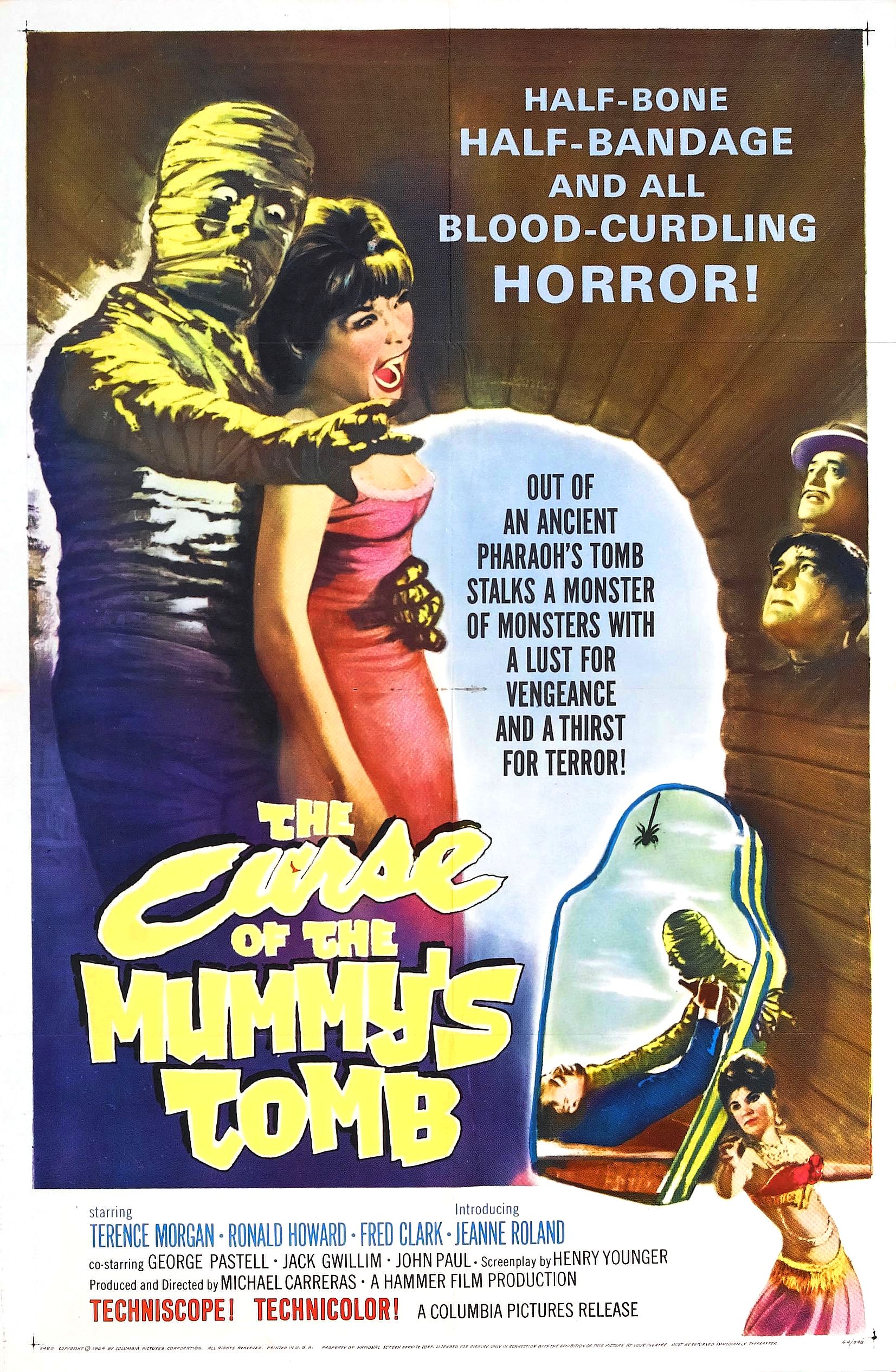
The Curse of the Mummy's Tomb (1964)

 "The public love to live dangeroiusly, as long as there's no real danger in it..."

Not every Hammer horror is a classic sadly. This isn't an awful film, and it looks gorgeous in places- the spectacle of the treasures from the toom, upon which we linger during the openimng titles, are so dsumptuous and impressibve we can very much forgive the obvious matte painted backgrounds in the obviously studio-bound desert scenes early on.

This is, I suppose, a fairly traditional mummy romp. The mummy looks good. The plot is decent, although one has to raise an eye at Adam's seduction technique of saying that an intelligent woman should not be a bluestocking but should instead use her intelligence to run a household and not worry her pretty little head over all that academic learning. Well then.

There's a very vulgar American stereotype, an ncultured P.T. Barnum wannabe. There's the inevitable George Pastell as a native Egyptian red herring, a man who proves to have noble intentions, even if his unexpected heroic sacrifice is shrouded in embarrassing stereotyping. 

Yet what stops this film quite catching fire, I think, is partluy that the cast, while generally competent, does not quite have the charisma that one would expect from such a film. There are no real stars and, while it's not necessarily a bad thing to cast character actors as leads, here it doesn't quite work. Everyone is competent onscreen but there is no magnetic screen presence.

Then there's the slow pacing in what is an awfully padded fim for one so short, and the fact we don't even see the mummy until far toolate. That said, though, the film is well made,and George Pastell is superb even if the stereotyped part he plays is not.

Friday, 11 December 2020

Santa Claus Conquers the Martians (1964)

 "You'll never get away with this, you Martian!"

Why not watch this silly bit of seasonal low camp silliness, I thought. Just how bad can it be?

Well... very bad. Very bad indeed. Come back, Teenagers from Outer Space; all is forgiven. In fact, bah humbug. This is a film in which Martians kidnap Santa Claus by using a silly '50s robot that may actually be made from cardboard boxes. This is a film where two children, dressed normally yet just feeling a bit cold, are menaced in the North Pole by a polar bear that is obviously a main in a suit on all fours- and this isn't even a low point.

This is, indeed, a film centred around the concept that Martian kids are a bit subdued and in need of cheering up, so the Martiand kidnap Santa. Yes, really. Also, the music is horrible, athough intentionally funny in places. But the film, overall, struggles to meet even the basic requirements of low camp fun, dragging despire its short length and being much better to read about than to watch. John Case is actually a pretty good Santa but the rest of the cast, quite wisely, phone it in. I'd recommend this to the connoisseur of awful cinema, but this film should not under any circumstances be approached without alcohol.

What's extraordinary, though, is that it all seems to be done with a straight face. Someone made, financed and promoted this film, presumably believing on some level that it was, if not good, at least not an unforgivable crime against culture. I suppose, for that reason, if no other, it ofers us some much-needed mindless optimism during this plague-ridden Christmas as our equally mindless prime minister threatens to hurl us into economic hell out of sheer xenophobic stupidity. Ho ho ho.

Sunday, 25 October 2020

Crypt of Horror (1964)

 "In some houses death is a tenant."

This is, so to speak, a spaghetti horror, with Christopher Lee being a kind of Clint Eastwood here (not a phrase I ever thought I'd write) as the star and only native English speaker amongst a largely Italian cast in L'Aquila. It's reasonably straightforward sdaptation of Sheridan Le Fanu's Carmilla with a few names changed but the plot largely left intact, and will be interesting to compare with Hammer's The Vampire Lovers when I inevitably get there.

And it's the plot that makes this film surpisingly good. Lee is, as ever, superb, and well-cast as a Count Karstein who worries that his ill daughter may have been possessd by the spirit of a powerful witch of an ancestor- a true gothic situation with an evil from the distant past threatening a castle and deserted village. The historical Italian setting really emphasises this sense of an ever-present past threatening the present.

This film is, perhaps, a collection of all the usual '60s horror film tropes with all the above plus more. But what makes it special is the unusally intricate plot, with twist and turns throughout and a rather effective whodunit element towards the end. It's weird that all the dialogue except Lee's is dubbed, but the script is surprisingly strong and the film well-directed, and done as straight horror with no ttempt at high camp whatsoever- a dangerous thing to mattempt with this sort of film but just about pulled off successfully.

Overall, this is surprisingly good, and deserves an audience beyond the usual Christopher Lee completists.

Friday, 7 February 2020

King Ghidorah the Three Headed Monster (1964)

"Is Jupiter in Africa?"

 This film is, of course, completely bonkers- the mere fact that it ends with Godzilla, Rodan and Mothra teaming up to defeat three headed alien beast King Ghidorah tells you that. But it never ceases to be entertaining, the model work is if anything better than ever and Ishiro Honda's usual cast of actors do a sterling job as ever.

The plot ain't half bizarre, though. They squeeze in a sub-plot about a princess from a fictional country chased by agent of the new tyrannical government (possible influence on Star Wars...?!), only for said princess to survive an exploding plane and have her body temporarily inhabited by the consciousness of one of the long dead precognitive inhabitants of Jupiter who were wiped out five millennia ago by the terrifying King Ghidorah. As you do.

Oh, and loads of meteorites land, one of which later hatches King Ghidorah himself. Was Quatermass II (presumably the film) an influence here?

We also have more stuff with Infant Island, more (thankfully no longer blacked up) "natives and those little fairy women, except that this culture that was so proud of its religion and culture in Mothra is now happy to be used to provide content for a Japanese light entertainment programme. Well then.

Arguably, perhaps, the four(!) monsters we have here don't get enough screen time, but the monster set pieces we do see are utterly splendid, and King Ghidorah himself is, relatively speaking, a triumph of both design and execution. This film is utterly, utterly B movie but, provided you're in the mood, it's fast moving and enormous fun.


Friday, 17 January 2020

Mothra vs Godzilla (1964)

"We feel that we cannot trust humans..."

Another Godzilla film, methinks. And, while we're at it, lets do a sequel to Mothra. And let's make an obviously cheesy B movie notably better than it's expected to be, or needs to be. Even if the cast is starting to look awfully familiar- didn't Japan in the '50s and '60s have a wider group of B movie star actors than this?

Because this film is, indeed, better than it needs to be. Oh, it's more of a sequel to Mothra with Godzilla, despite his screen time, just a prominent guest star, but this simply reflects Mothra's deeper backstory, being goddess of an island in the Pacific whose inhabitants, thankfully, are not blacked up this time.

But there's a proper plot, with story beats in the right places. A giant egg is found; human greed leads to its usual silliness; and then those two miniature ladies from Mothra turn up to provide some much-needed exposition, and for some reason seem to know what a hydrogen bomb is.

But it all works, plot-wise, and masterfully builds both tension and interest. Godzilla arrives and wreaks the usual havoc to an unnamed city that we shall call, well, "Tokyo" which looks, suspiciously, to be entirely made of models. Our heroes- the by-now familiar combo of male journalist with social conscience, klutzy but moral female photographer and obligatory generic scientist- are forced to go to that island from the last Mothra film to beg for help. Fortunately, to a degree, the "natives" are presented with a little more dignity this time. And so Mothra heads to Japan to battle Godzilla and an epic battle ensues after which she, er, dies of old age.

The film concludes as we wait for the egg to hatch in order for a baby Mothra (or two) to give Godzilla the spanking that the short remaining running time demands. It all commands the attention rather strongly, weird though it is to have Iwo Jima mentioned in a film which doesn't star John Wayne. And yes, Ishiro Honda gives s the usual splendid set pieces. A magnificently entertaining film.

Sunday, 29 September 2019

The Last Man on Earth (1964)

“You’re freaks, all of you!”

I never did read Richard Matheson’s novel, or any of the other film adaptations, which made me pleasantly unspoiled for this strange little English language Italian film, starring Vincent Price and some Italian actors with impressive language skills, much though the concept reminds me of Day of the Triffids.

What I particularly love about this is that it’s a proper tragedy, not just in the sense of misfortune but how Dr Morgan exhibits hubris, and a tragic flaw. This turns it from a fascinatingly done but nonetheless fairly predictable post-apocalypse world into something more, and allows a trust ending.

Most of the film is taken up with Morgan’s daily life as the last man alive, using garlic, mirrors and plentiful cars to loot so he can survive and slowly kill as many sleeping vampires as he can during the daytime. He even keeps track of the date (civilisation ended in 1965!) for the benefit of nobody but himself, a defiant gesture. This is interspersed with flashback scenes of the “bacterium” slowly killing off civilisation and humanity, including his wife and daughter, until he is utterly alone- organised, determined but empty inside. Vincent Price, cast very much against type, gives a magnificent performance here which is very different from the parts he usually plays, although sadly his appearance and voice mean that Richard Mathewson was probably right to consider him miscast.

The final minutes of the film are a hammer blow- at first it seems Morgan is not alone, but the other survivors are merely infected people who are able to manage their condition with medication. They kill him because, amongst the vampires he has killed, have been some of their people and he, the last remaining “pure” human, is a threat. Morgan does knowing that humanity and civilisation will indeed eventually survive- without him. It’s a devastating twist for a rather good little film.

Saturday, 20 July 2019

A Fistful of Dollars (1964)

“You’ll get rich here, or you’ll be killed.”

I saw this film on DVD many years ago as a twentysomething, and remembered very little about it. I know, though that this and Sergio Leone in particular are supposed to be highly regarded, this is said to be a prime example of the spaghetti western and of Clint Eastwood’s loner type character. Also, I’ve only seen a couple of proper Westerns at this point (High Noon and The Man Who Killed Liberty Valance). So I’m not saying anything here with any deep knowledge of the genre.

I can say that the Spanish locations look convincing as the American West and the setting, just into Mexican territory, means the film can just about get away with the fact that Eastwood is the only(!) American actor. And yes, the film works very well on a basic level- Eastwood convinces as the mysterious but intelligent loner, cynical but not without morals deep down, who cleverly plays the two criminal families that are destroying a town against each other to eliminate them both. Plus the whole thing is well shot.

Except... the other Westerns I’ve seen were about something, about moral dilemmas and doing the right thing where it isn’t clear or easy and where there may be no reward. They were about character, in both senses of the word. They had depth, and worked as drama. This is... well, it’s a good action film but an action film is what it is. Do Westerns not necessarily have that depth I’ve seen before? Are spaghetti westerns different and a bit more superficial? Is Clint Eastwood known for this kind of more superficial Western? I’m sure I’ll slowly find out.

Incidentally, this is pure coincidence but the previous film I saw was Back to the Future, Part II, which had a clip from the climax. But surely, if Biff Tannen changed history in 1955, the butterfly effect would mean the same film in 1964 would never quite appear?

Saturday, 15 June 2019

The Masque of the Red Death (1964)

"Each man creates his own God for himself, his own Heaven, his own Hell."

I'd seen and blogged a couple of Roger Corman’s Poe films before, and found they’ve always been impressive in how they were scripted, shot and acted. But this one absolutely stands out as the finest by far. It’s superb, taking an Edgar Allan Poe short story and making a dark philosophical treatise that almost echoes Bergman’s The Seventh Seal.

The setting is simple; a gothic castle in Renaissance Italy and the dark, plague-ridden countryside. But the film eschews realism in order to make the countryside darkly stylised, while there’s a sense that this community is cut off from the rest of Italy, giving Prince Prosperous absolute power over all he surveys. An openly Satanist prince would not possibly have been able to survive in Renaissance Italy, of course, but the film exists in its own claustrophobic, deeply atmospheric little world.

And at the centre of it all is the magnificent, extraordinary Vincent Price, giving one of the performances of his career. His mellifluous voice, the arch of his eyebrow, the looks of sardonic sadism- all this makes him utterly compelling as a charming sadist with absolute power and a love of Satan. There are subplots- Hazel Court as a princess fated to a gory death after giving herself to the Devil, and the horrifying revenge of a dwarf for the insult to his lady- but the film entirely focuses around the compelling figure of Prospero, and his eventual comeuppance is glorious.

I’ve blogged a fair few Roger Corman films by now, many of them excellent. But this is his finest achievement by far.

Saturday, 22 September 2018

Onibaba (1964)

"I've never seen anything really beautiful since the day I was born."

Mark Kermode, in his recent BBC4 documentary on cinematic genres, said that this was one of the most terrifying films ever. Having seen it, I quite agree.

Not that you'd think so, in spite of the disturbing camerawork and cinematography throughout, playing on the long grass and that deep, ancient hole; for most of its length, this film is a drama centred around but three characters, seeming almost to be a stage play if not for the cinematography and the deep, disturbing mood of the long, long grass.

The mother and daughter-in-law around whom this film centred are not named, but when their son/husband's mate arrives, back from the war, self-centred and uncaring about the death of his friends, so important to the two ladies. And yet the widowed daughter-in-law soon starts an affair with this unmannered brute, much to the profound horror of her mother in law. Oh, and, incidentally, there's a never-ending civil war (it's the 14th century), and the two ladies are killing wounded samurai and selling their stolen possessions for millet. It's war, brutal war, and morality s long gone in the desperate urge to survive. None of the characters are likeable, but the fact that much of the film has the intimacy of a stage play with its limited cast of (pretty much) three characters, none of whom are likeable but all of whom feel real and are compelling.

It's kept ambiguous whether the mask that forms the horror is supernatural or not, but that's as it should be as unease erupts into terror. This film is superb and truly horrifying.

Friday, 21 April 2017

Dr. Strangelove or: How I Learned to Stop Worrying and Love the Bomb (1964)

"Mr. President, we must not allow a mineshaft gap."

This isn't the first time I've seen Dr. Strangelove, which is probably a good thing: this time I was able to look past the hilarious script and superb comic performances from, yes, Peter Sellers but the whole cast to Kubrick's superb direction and, perhaps, a slightly deeper context.

Still, it's worth emphasising that not only is this one of the funniest films ever but Sellers is utterly, utterly outstanding in all three of the parts he plays. Sterling Hayden deserves a mention, though, as does the utterly hilarious George C. Scott. And yet.... the Cuban Missile Crisis is less than two years ago and the film was made at what must have been the absolute peak of absolute nuclear annihilation. Strip away the comedy and this is a bleak and terrifying film (the concept of the Soviet doomsday device alone is existentially fearsome) which ends in absolute nuclear holocaust to the strains of Vera Lynn. And yet I think that both the humour and the underlying bleakness owe much to Catch-22 (the extraordinary novel: I haven't seen the film), another example of absolutely dark and horrible subject matter being leavened by a very mid-twentieth century absurdist style of humour which brings us back, again, to the existentialism which underpins this film, one of the greatest ever made.

Oh, and it's great, if weird, to hear the imperial tones of James Earl Jones in a film thirteen years before his signature role!

Friday, 26 February 2016

First Men in the Moon (1964)

"Not married?!! Kindly leave the room!"

It rather pleases my geek sensibilities to see that Ray Harryhausen worked on a film co-written by Nigel Kneale. Harryhausen isn't really called upon to do much in comparison with some of his other work, but this is still a damned fine adaptation of H.G. Wells' little parable on the evils of capitalism.

I note, of course, that the baddie is a Mr. Bedford- sounds a well dodgy type, although I have no idea why "Julius" was changed to "Arnold" for the film. Rather spoils the "Caesar in Gaul" subtext.

It's 1964. The late St John F. Kennedy of blessed memory has alteady vowed to put a man on the moon by the end of the decade, and both superpowers are quite visibly and excitingly progressing towards that age. Bliss was it in that dawn to be alive, when the future was not yet passé. They would have been appalled to discover that, as of 2016, no one has set foot on the moon for a staggering 44 years. It was a very different age, but also a very different age from 1901 when the novel was published. So it's good to see the story bookended by modern day sections in which astronauts discover evidence of Cavor's exploits. It's rather utopian to propose a multinational UN mission, though. And rather fanciful to suggest that the Yank and the Russian would be joined by a Brit...!

Still, it frames the film nicely. It's surprisingly late on until our (anti-)heroes reach the Moon, but the design and effect is fantastic much they do. I'm reminded visually of The Daleks, a Doctor Who story of the same year: must have been something in the zeitgeist.

It's an excellent version of a much under-utilised novel, in spite of it's largely unknown cast. That ending, though? Shameless rip-off from The War of the Worlds. H.G. Wells should sue himself.

Thursday, 21 January 2016

Goldfinger (1964)

"Some things just simply aren't done. Like drinking Dom Perignon '53 at above 38 degrees Fahrenheit. Or listening to the Beatles without earmuffs."

Well, Bond's taste in music is pants, then.

Let's get one thing straight, first: I liked this film a lot. But... well, I like the James Bond films. I've seen most of them, some several times, but not all them. I haven't seen Goldfinger before for instance. But I'm vaguely aware that the received opinion of this film is that it's amongst the best. But, well, I liked it very much but I liked it's predecessors better.

Why? I'm not entirely sure. Perhaps it feels smaller in scale? Perhaps the locations aren't as big or exciting, with long scenes in golf clubs and dull cells, and Bond spending much of the last part of the film as a prisoner? I think it's mainly that Gert Frobe is ok but not all that good or charismatic. Even the "No, Mr. Bond, I expect you to die!" moment underwhelmed me. Has popular culture led me to expect too much?

Still, Connery is awesome as ever.and the full on gadgetry emerges with the gadget filled Aston Martin and a glimpse into "Q" branch. There are some good set pieces, too, most notably Jill Masterson being killed from asphyxiation after being covered in gold paint, as so splendidly debunked in Mythbusters.

Honor Blackman is suitably icy as the deliciously named Pussy Galore, but.. well, the sexual politics of the Bond films have raised a good number of eyebrows up until now, with all the slapping and somewhat unreconstructed attitudes, but Bond quite unambiguously subjects Pussy to sexual assault. It isn't depicted as rape, with Pussy clearly shown to be yielding... but that in itself is troubling.

Still, it has the best theme tune so far and possibly ever. And is still a bloody good film.

Monday, 14 September 2015

A Hard Day's Night (1964)

"What would you call that hairstyle you're wearing?"

"Arthur."

At long last I get to see this film; I've no idea why I hadn't seen it before. It's great, of course; it has no it as such but it has laughs, great dialogue, plenty of great Beatles tracks including the classic title track, and the superb comic performances of all four Beatles themselves, none of whom are trained actors. And all this at a time when they were insanely busy.

Wilfrid Brambell is also great as Paul's discreetly gay Irish "grandfather", and George gets a great scene where he puts the boot into the fashion industry. It's not just the Beatles themselves who date the film; you can tell the film was made at the tail end of the satire boom, and there are lots of little digs at the class system to echo John's quip about the rich people rattling their jewellery at the Royal Variety Performance.

As the film ends, with absolutely nothing having happened, you're left with a nostalgic smile on your face. I love this film.

Saturday, 23 March 2013

Mary Poppins (1964)


“Supercalifragilisticexpialidocious!”
 
Yes, I really am doing this. All these horrors and I go and blog Mary Poppins. What can I say? It amuses me. I won’t pretend this sort of thing is usually my cup of tea, but I actually rather enjoyed it. In fact, I’m full of regrets about waiting until the age of almost thirty-six to see it. This is the perfect film for children, with everything about it firing the imagination of the child within us all. It’s forever deriving fantasy from the mundane and ordinary. A simple bag becomes a magical repository of all things. You can jump into pictures and become a cartoon. Plus there are songs and that. Julie Andrews is captivating as our heroine, and her voice is extraordinary.

The one thing everyone knows about this film is that Dick Van Dyke’s “cockney” accent is said to be awful by all. In fact, it is far more jaw-droppingly atrocious than I would have had the power to imagine. I would be very much surprised if this were not the worst accent in the history of cinema. Having said all that, I worry that I may have underestimated just how bad it is! It’s a pity. Van Dyke is actually pretty good when it comes to the actual acting, giving us a likeable and charismatic Bert, but you’re far too busy laughing at the accent to take any notice of what he’s doing.

This is very much a tourist friendly version of London and, for that matter, a version of 1910 which has been sanitised for the children of the 1960’s. Knowing that this is a Disney film I was looking for reactionary sentiments throughout, which was an interesting exercise. One of our first songs appears to mock the Suffragette movement, and the character of Bert portrays the hard life of Edwardian poverty as not only bearable but positively fun. This may appear to show conservative attitudes to both gender and class issues, but, these are interestingly subverted at the end, where Mr Banks’ patriarchal authority is undermined by both of these things.

The whole look of the film is a bit of a jolt after so many more modern films in a row. The tanned faces, the technicolour picture quality and the matte painting backgrounds give the film a retro charm that contemporary audiences would have never seen.

Mary Poppins herself is a force of nature. Yes, we see this in her interaction with the children, but the best moments for the character are those in which she wraps Mr Banks right round her finger. She is, essentially, the perfect Edwardian woman- unflappable, infinitely capable, sexless, and maintaining the very stiffest of upper lips in the silliest and most surreal of circumstances. This, of course, is what makes her so damned charismatic.

Some of the social attitudes are fascinating. It’s only 1964, but the film shows a strangely modern hostility to fox hunting. I never knew, though, that apparently foxes can be Irish! I raised an eyebrow, given the bastardry of banks in recent years, at their negative portrayal in this film. A run on a bank is a rather more alarming thing to see nowadays than it would have been at the time.

This film is quite, quite mad. We have an Admiral who keeps his house like a ship and shoots at chimney sweeps. We have a carousel where one can ride the horses away. We have animated fireworks that look like something out of Yellow Submarine. We even have an Englishman who pronounces “niche” as “nitch”. Grrrrr! The ending is simultaneously reinforcing of the patriarchal family structure and subversive of it, a nice touch. Mary Poppins buggers off as the wind changes: this apparently orderly and conservative figure is, underneath, capricious and chaotic, and brings whimsy to all she touches. I never thought I’d say this, but I love this film.