"Announcing your plans is a good way to hear God laugh..."
This season finale is fascinating, thematic, perfect, and very much centred on the difficulties and dilemmas facing its two central characters as the military and magistrate arrive. Annexation and civilisation are almost here, and both Al and Seth must face what it means for them.
We begin as the camera pans away from Al, for whom the moment of truth arrives: the magistrate with the warrant for his arrest on a capital charge. He eventually deals with this problem decisively, but not without risks that the problem will return. And yet he carries out a more merciful killing, too: that of poor Reverend Smith, at the subtle urging of an upset and despairing Doc, who can at least take solace in the fact that his care has made a positive difference to a cheerful and smiling Jewel as he drinks himself to oblivion.
Al has other problems, though. The newly appointed sheriff is corrupt and, worse, acting in the interests of Cy in striking at Mr Wu and the Chinese. And this is not a problem, to Mr Wu’s fury, he can make go away.
Worse, Alma’s father turns out to be an utter blackguard, who wants to use his daughter to finance his growing and huge gambling debts- and is willing to blackmail his own daughter to achieve this. Seth, ever the gentleman, gives him a jolly good thrashing for being a cad and boulder- but comes close to arranging his murder at the hands of Al. At last he comes back from the abyss, but not before breaking his empty wedding vows by finally shagging Alma- and accepting, at last, with Al’s blessing, the position of sheriff.
This is a finely crafted, multifaceted ending to a superlative first season. I’ll be back before too long to begin the second...
Showing posts with label Jeffrey Jones. Show all posts
Showing posts with label Jeffrey Jones. Show all posts
Wednesday, 19 August 2020


Thursday, 6 August 2020
Deadwood: Season 1, Episode 10- Mister Wu
“August commencement to my administration, standing stymied outside a saloon next to a degenerate tit-licker.”
This is a subtle, well-written script, well realised. As ever, there’s a lot going on. The Reverend continues to deteriorate- the Doc thinks it’s a tumour. Business is good for Charlie while Joanie is stuck. Fascinatingly, Bullock honestly talks to Sol of his doubts about a wife and boy he barely knows as “she” is a beautiful woman. But the episode is, as ever, about the town’s slow process towards annexation and order... and systemic racism.
The episode shows us the racism, and doesn’t tell us how to react. Certainly, Wu is not a nice man. He supplies opium to Al and feeds murdered bodies to his pigs- and the other members of the Chinese community are clearly afraid of him. He is, I suppose, a community leader of sorts- but, because of his ehnicity, there's no possibility of his being considered one, and there is uproar when he enters the Gem through the front door. He is, in a sense, respected- certainly by Al- as an individual, but it seems to be accepted by all that there's a "proper" separation of "races". Racial slurs are everywhere, whores find his entering by the front door scandalous, and Cy even comments that a white dope fiend is "still while"- and Al is wary of being seen as too close to the "celestials".
It's interesting that this structural racism is clearly shown, and shocks with how clearly ingrained it is, without a need for a sympathetic character. Interestingly, too, we meet Hostetler, our first black character.
Beyond this, civilisation grows nearer, although not without Al having to pay extra bribes to make a murder charge go away. Already there's tension between using tax for corrupt purposes and for public services. There's a lot of nuance and subtlety here. It is, as ever, superb telly.
This is a subtle, well-written script, well realised. As ever, there’s a lot going on. The Reverend continues to deteriorate- the Doc thinks it’s a tumour. Business is good for Charlie while Joanie is stuck. Fascinatingly, Bullock honestly talks to Sol of his doubts about a wife and boy he barely knows as “she” is a beautiful woman. But the episode is, as ever, about the town’s slow process towards annexation and order... and systemic racism.
The episode shows us the racism, and doesn’t tell us how to react. Certainly, Wu is not a nice man. He supplies opium to Al and feeds murdered bodies to his pigs- and the other members of the Chinese community are clearly afraid of him. He is, I suppose, a community leader of sorts- but, because of his ehnicity, there's no possibility of his being considered one, and there is uproar when he enters the Gem through the front door. He is, in a sense, respected- certainly by Al- as an individual, but it seems to be accepted by all that there's a "proper" separation of "races". Racial slurs are everywhere, whores find his entering by the front door scandalous, and Cy even comments that a white dope fiend is "still while"- and Al is wary of being seen as too close to the "celestials".
It's interesting that this structural racism is clearly shown, and shocks with how clearly ingrained it is, without a need for a sympathetic character. Interestingly, too, we meet Hostetler, our first black character.
Beyond this, civilisation grows nearer, although not without Al having to pay extra bribes to make a murder charge go away. Already there's tension between using tax for corrupt purposes and for public services. There's a lot of nuance and subtlety here. It is, as ever, superb telly.
Tuesday, 23 June 2020
Deadwood: Season 1, Episode 6- Plague
"Swearingen's a cue and Farnum merely is a billiard ball."
There's a lot happening in this episode besides the title. Alma continues to pretend to be a junkie still while undergoing cold turkey, fooling E.B., playing for time until seth returns. Seth, meanwhile, is attacked by an opportunistic Sioux, succeeds in killing him with a rock, and is ultimately rescued by Charlie Utter, who now learns of Bill's death. It now seems they are after Bill's killer, but it looks as though this plot thread is to simmer for a bit. Good strategic writing.
Jane is a fascinating character- very much not conforming to the archetype of a lady, acting in many ways like a man, portrayed here (and potentially in reality) as of possible LGBT nature, to use an anachronism; her sexuality and, indeed gender identity, is as ambiguous as one might expect in 1876.
But she is a fully rounded person- drunk to blot out the memory of her best friend's death, but having cared for what she knows full well was a amallpox sufferer at the end of last episode. She's uneducated, uncouth, unladylike, deeply racist as per her upbringing, but not unkind beneath it all.
Then there's Joanie, who seems a bit down- but could the harsh, cynical Cy Tolliver have a thing for her? This promises to be a subtle little character thread that could run and run. Again, good writing. And the Doc, a decent man, taking centre stage while Merrick, a stereotypical newspaperman, is upstaged by Al in reporting the arrival of smallpox.
The arrival of this pestilence in the settlement dominates the episode, which makes it resonate somewhat now in June of 2020. It leads to stage managed fear and, fascinatingly, a meeting of the great and the good in which both Al and Cy relish the role of community leader and both reconcile somewhat. And we see the Reverend Smith collapse- very publicly- with his second fit. This is superbly written drama. I'm loving Deadwood, and we are nearly halfway through this first season.
There's a lot happening in this episode besides the title. Alma continues to pretend to be a junkie still while undergoing cold turkey, fooling E.B., playing for time until seth returns. Seth, meanwhile, is attacked by an opportunistic Sioux, succeeds in killing him with a rock, and is ultimately rescued by Charlie Utter, who now learns of Bill's death. It now seems they are after Bill's killer, but it looks as though this plot thread is to simmer for a bit. Good strategic writing.
Jane is a fascinating character- very much not conforming to the archetype of a lady, acting in many ways like a man, portrayed here (and potentially in reality) as of possible LGBT nature, to use an anachronism; her sexuality and, indeed gender identity, is as ambiguous as one might expect in 1876.
But she is a fully rounded person- drunk to blot out the memory of her best friend's death, but having cared for what she knows full well was a amallpox sufferer at the end of last episode. She's uneducated, uncouth, unladylike, deeply racist as per her upbringing, but not unkind beneath it all.
Then there's Joanie, who seems a bit down- but could the harsh, cynical Cy Tolliver have a thing for her? This promises to be a subtle little character thread that could run and run. Again, good writing. And the Doc, a decent man, taking centre stage while Merrick, a stereotypical newspaperman, is upstaged by Al in reporting the arrival of smallpox.
The arrival of this pestilence in the settlement dominates the episode, which makes it resonate somewhat now in June of 2020. It leads to stage managed fear and, fascinatingly, a meeting of the great and the good in which both Al and Cy relish the role of community leader and both reconcile somewhat. And we see the Reverend Smith collapse- very publicly- with his second fit. This is superbly written drama. I'm loving Deadwood, and we are nearly halfway through this first season.
Tuesday, 9 June 2020
Deadwood: Season 1, Episode 5- The Trial of Jack McCall
"Hickock breaks my balls from the afterlife..."
This is another multifaceted, complex gem of an episode as the people of the town walk past Wild Bill's body to pay their respects while a man stands around loudly trying to sell the severed head of a "heathen" Inevitably, this lawless community moves to try the killer, but the issues surrounding this are fascinating and fundamental. Meanwhile, so many characters get meaningful development.
Bullock is grumpy all episode, particularly with the ingratiating evangelism of the Reverend Smith- it seems that, like many quietly irreligious people in societes where outright atheism is frowned upon, this makes him very uncomfortable. Yet Smith himself is behaving strangely, and ends the episode with some kind of seizure. This is a man we know to have been traumatised by war- there are clearly depths to him.
E.B. shows signs of deep resentment towards Swearengen, and signs of an independent agenda. He's a man needing security for his declining years. Meanwhile Al is getting Trixie to manipulate the newly widowed Alma by replacing her addiction to laudanum with another substance as part of Al's getting her caim back. But she's leaving her agency in the literal hands of a man (not much feminism in 1876)- and, if the first meeting between her and Seth is anything to go by, a man she rather likes the look of. Future lovers, I wonder?
Meanwhile the relationship between Tolliver and mistress Joanie is shown to be complex- how loose is her leash? And she clearly has desires of a Sapphic nature. Tolliver, callously, has his sick old friend Andy dumped in the wilderness where he finds himself looked after by a drunk but nevertheless crudely kindly Calamity Jane, upset at the loss of her "best friend" who never judged her. This is all masterful character development.
But the trial is fascinating- and so is Al's word with the judge. Does this lawless community, wishing for eventual annexation by the United States, really want to look like a society with pretensions of its own legal system, a part of the infrastructure of a functioning state? Would this not be a provocation? And yet, what else can they do?
The killer is ultimately acquitted, and genly reminded to leave town pretty sharpish. But it seems, from coughng at Bill's funeral, that getting rid of Andy (not quite dead) may have brought a plague. How very topical.
This is superlative television.
This is another multifaceted, complex gem of an episode as the people of the town walk past Wild Bill's body to pay their respects while a man stands around loudly trying to sell the severed head of a "heathen" Inevitably, this lawless community moves to try the killer, but the issues surrounding this are fascinating and fundamental. Meanwhile, so many characters get meaningful development.
Bullock is grumpy all episode, particularly with the ingratiating evangelism of the Reverend Smith- it seems that, like many quietly irreligious people in societes where outright atheism is frowned upon, this makes him very uncomfortable. Yet Smith himself is behaving strangely, and ends the episode with some kind of seizure. This is a man we know to have been traumatised by war- there are clearly depths to him.
E.B. shows signs of deep resentment towards Swearengen, and signs of an independent agenda. He's a man needing security for his declining years. Meanwhile Al is getting Trixie to manipulate the newly widowed Alma by replacing her addiction to laudanum with another substance as part of Al's getting her caim back. But she's leaving her agency in the literal hands of a man (not much feminism in 1876)- and, if the first meeting between her and Seth is anything to go by, a man she rather likes the look of. Future lovers, I wonder?
Meanwhile the relationship between Tolliver and mistress Joanie is shown to be complex- how loose is her leash? And she clearly has desires of a Sapphic nature. Tolliver, callously, has his sick old friend Andy dumped in the wilderness where he finds himself looked after by a drunk but nevertheless crudely kindly Calamity Jane, upset at the loss of her "best friend" who never judged her. This is all masterful character development.
But the trial is fascinating- and so is Al's word with the judge. Does this lawless community, wishing for eventual annexation by the United States, really want to look like a society with pretensions of its own legal system, a part of the infrastructure of a functioning state? Would this not be a provocation? And yet, what else can they do?
The killer is ultimately acquitted, and genly reminded to leave town pretty sharpish. But it seems, from coughng at Bill's funeral, that getting rid of Andy (not quite dead) may have brought a plague. How very topical.
This is superlative television.
Saturday, 11 May 2019
Ed Wood (1994)
"Nobody cares! These movies are terrible!"
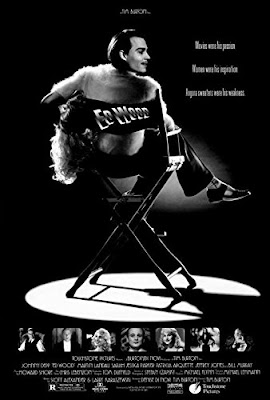 That Tim Burton would make a biopic of Ed Wood is delicious. That it should be so bloody good is even more so. Monochrome, stylised and deeply evocative of both 1950s Hollywood and the schlock genres, this is a well-structured, good-natured and fun look at one of Hollywood’s more eccentric “talents” with an extraordinary performance of Johnny Depp at the centre of it all.
The opening titles, with the parade of ‘50s genre tropes and the glorious theremins, are wonderful, and set the mood perfectly. Then we move to setting up who Ed is, his transvestism, and the story of Glen or Glenda, complete with lots of 1950s trans people including the aristocratic but delightfully camp “Bunny” Breckinridge, played to perfection by Bill Murray. We then follow Ed’s, er, career right through to Plan 9 from Outer Space and see him happily married to a fellow geek- and then we stop, before we get any hint of his decline, alcoholism and early death.
Instead we see the tragedy of the great Bela Lugosi’s final years, forgotten by Hollywood to the point of appearing in Ed’s films, alone, homesick for a Hungary to which he can never return, behind an Iron Curtain. Martin Landau plays him with skill and much pathos, but also not without humour (“Karloff does not deserve to smell my shit!”).
We also see Juliet Landau (nepotism; fun for all the family), bizarrely using her native accent, and a superb cameo by Vincent D’Onofrio as the great Orson Welles. But this film belongs to Depp, and to Burton, who has conjured up perhaps his finest cinematic world.

The opening titles, with the parade of ‘50s genre tropes and the glorious theremins, are wonderful, and set the mood perfectly. Then we move to setting up who Ed is, his transvestism, and the story of Glen or Glenda, complete with lots of 1950s trans people including the aristocratic but delightfully camp “Bunny” Breckinridge, played to perfection by Bill Murray. We then follow Ed’s, er, career right through to Plan 9 from Outer Space and see him happily married to a fellow geek- and then we stop, before we get any hint of his decline, alcoholism and early death.
Instead we see the tragedy of the great Bela Lugosi’s final years, forgotten by Hollywood to the point of appearing in Ed’s films, alone, homesick for a Hungary to which he can never return, behind an Iron Curtain. Martin Landau plays him with skill and much pathos, but also not without humour (“Karloff does not deserve to smell my shit!”).
We also see Juliet Landau (nepotism; fun for all the family), bizarrely using her native accent, and a superb cameo by Vincent D’Onofrio as the great Orson Welles. But this film belongs to Depp, and to Burton, who has conjured up perhaps his finest cinematic world.
Wednesday, 5 November 2014
Beetlejuice (1988)
"You know what they say about people who commit suicide- in the afterlife, they become civil servants!"
 Heaven forbid. What an awful fate.
Heaven forbid. What an awful fate.
I can't believe I've never seen this strange yet brilliant film before, a Tim Burton film from before he had quite settled on a particular style. It's delightfully quirky, and has the best stop motion effects I've ever seen in a film not involving Ray Harryhausen. Who needs CGI? Not the young Tim Burton.
It's also arresting to see Michael Keaton being brilliant in a comic role, and a very young Winona Ryder showing that she was the Dakota Fanning of her day. Best of all is the premise; a silly look at the haunted house genre from the perspective of those doing the haunting.
The whole things screams "late '80s", from the weird landscapes outside the house that look just like a contemporary music video to the fact that Lydia is an actual Goth who listens to Bauhaus rather than Evanescence. Along with the opera, that is.
There are some nice touches (I noticed the nod to The Cabinet of Dr. Caligari) to both the premise and the design, but probably the best thing is the bureaucracy after death. I'd better get used to it- I'm already a civil servant...
But the one thing I'll remember above all is the stop motion. It's glorious, and cartoonish, and, well, ripped off somewhat by Drop Dead Fred three years later. This movie rules!
Saturday, 28 April 2012
Howard the Duck (1986)
"That's it. No more Mr. Nice Duck!"

Admittedly, there are reasons to go in with low expectations. The quotes on the DVD cover, which are naturally going to be the most complimentary ones they could possibly use, are all about the special effects and nothing else. The film is "presented by" George Lucas, and any film which is "presented by" someone more famous is invariably directed by someone quite obscure. Also, back in those distant days before the Star Wars prequels when George Lucas actually had a good reputation, this was generally considered one of the worst things he's put his name to.
Actually, though, I was very pleasantly surprised. It's not a particularly great film, fair enough, but it's a pleasantly nostalgic experience to watch it today. Yes, the plot is a bit plodding, the tone overly sentimental and the jokes forced, but without these things it just wouldn't be a 1980s Hollywood adaptation. And the film lays on the 1980s-ness so heavily that it's hard to accept that it's from the real 1980s and not a modern pastiche of the 1980s that thinks it was all Rubik's cubes, shoulder pads, Mr. T and Boy George. Let's do a list, shall we?
- Lea Thompson is in it, and she's one of the most 1980s people ever. Plus, her hair is looking particularly 1980s. Oh, and she's lead singer in a band that's just like the Bangles.
- We have one of those sorts of nightclubs that are only ever seen in movies from the 1980s, complete with an extraordinary array of hairstyles and probably half the world's supply of hairspray.
- Howard gets shoved all the way along a bar until he falls off the end, and then walks purposefully across it to get his revenge. This only ever happens in 1980s film and TV.
- There's some outrageous product placement for, of all things, Heinz mustard and tomato ketchup.
- There's an end of level baddie at the end as the Dark Overlord attains his true form, thus indicating that we've just entered the age of the video game, and yet this monster is a rather splendid, Ray Harryhausen style stop-motion thingy that moves just a little too quickly and awkwardly but is nevertheless the greatest thing ever. This combination could have happened in no other decade.
So, yay for all that. Of course, the duck costume looks rubbish. Of course, you have to raise an eyebrow at how easy it seems to be for a literal illegal alien to get a job. And yes, the film translates very little of Steve Gerber's absurd humour and sharpness to the screen, although Beverley does utter the phrase "trapped in a world you never made". But this is fun, nostalgic to the point where even the rubbish bits are nostalgically rubbish, and features Lea Thompson with not many clothes on. What more do you want? Although it has to be said that the film only has a 12 certificate and yet there are rather broad hints of what is technically bestiality…!
Subscribe to:
Posts (Atom)